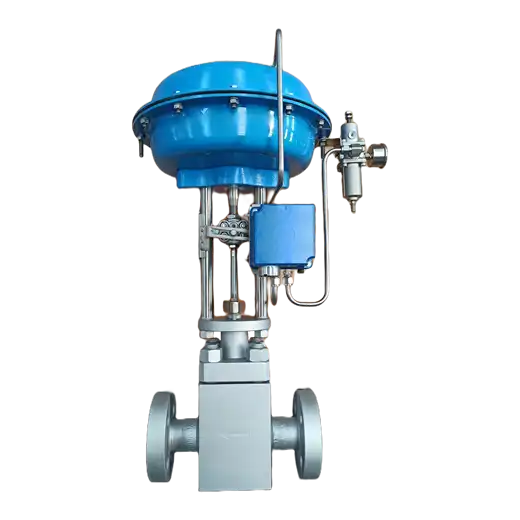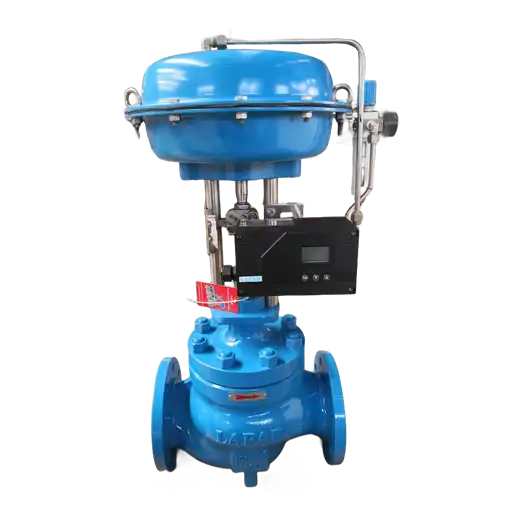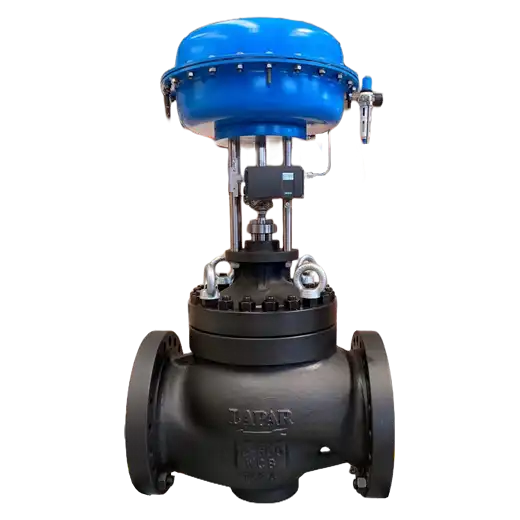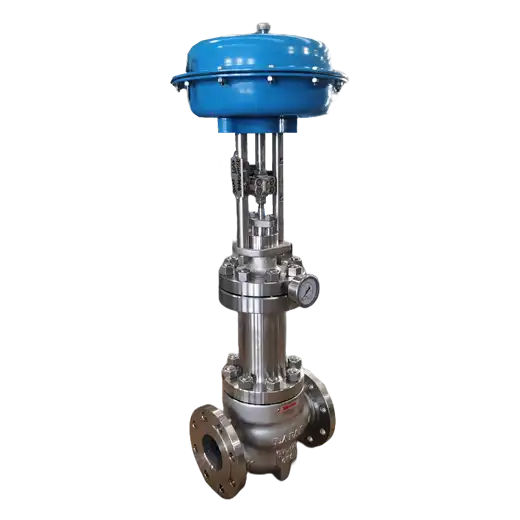
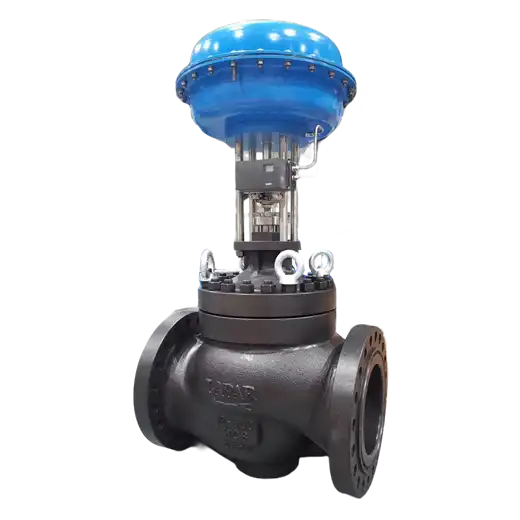
Cage Guided Double Seat Control Valve
Cage Guided Double Seat Control Valve is a force-balanced modulating valve whose two opposing seat rings cancel most plug thrust, delivering high flow capacity and stable control at large differential pressure with compact actuation, in DN 50 to DN 400 and Class 150 to Class 2500.
How a Cage Guided Double Seat Control Valve Works
The defining feature of a double seat valve is a force balance created by geometry rather than by hardware. Line pressure acts on two seating surfaces of different diameter — an upper seat and a lower seat — and the resulting thrusts push in opposite directions along the same stem axis. Because the two areas are close in size, most of the unbalanced force cancels out. What remains is typically a small fraction of what a single seat valve of the same bore would generate. That single physical fact drives every practical advantage of the design, and also its one unavoidable limitation.
Because net thrust is low, a given actuator can position the plug against a far higher differential pressure than a single seat valve would allow. In practice this means a smaller, cheaper, faster-responding diaphragm or piston actuator, less air consumption, and better control resolution at the same pressure drop. The cage guiding completes the picture: instead of relying on a slender stem alone for alignment, the plug is guided over a long bearing surface inside the cage itself. This suppresses plug vibration and flow-induced instability, holds the plug concentric with both seats through the full stroke, and dramatically extends trim life in high-velocity service.
The cage is also where the engineering is tailored to the process. Cage window geometry sets the inherent flow characteristic — linear, equal percentage or quick opening — and the same body can be re-characterised by changing the cage rather than replacing the valve. For noisy or cavitating service, multi-hole cages divide the flow into many small jets so that turbulence and acoustic energy are distributed and dissipated, and drilled-hole or multi-stage cages progressively step down pressure to keep the fluid away from its vapour pressure. For erosive service, plug and cage materials are hard-faced or specified in solid alloy. The trim library, not the body casting, is what makes one valve family cover very different duties.
One trade-off has to be stated plainly, because it is physics and no amount of machining removes it: a double seat valve cannot reliably achieve tight shutoff. As the valve changes temperature, the body and the two seat rings expand at different rates, and the axial distance between the upper and lower seats shifts. Both seats cannot then load simultaneously. Class II is typical, Class III is achievable with precision lapping and controlled installation, Class IV is possible on selected designs — but Class V and Class VI bubble-tight closure should not be specified here. Where tight shutoff and low actuator thrust are both required, a pressure-balanced single seat cage-guided valve is the better choice, and we will recommend it. Where they are not both required, the double seat valve delivers higher capacity, greater stability and lower actuation cost than anything else in its size range.
Key Features
Force-Balanced Trim Requires Far Less Actuator Thrust
Two opposing seating surfaces cancel most of the unbalanced plug force, so a compact diaphragm or piston actuator can position the plug against differential pressures that would demand an oversized actuator on a single seat valve. The result is lower installed cost, reduced air consumption and finer control resolution at the same pressure drop.
High Flow Capacity for Its Body Size
Flow enters and leaves through two parallel paths rather than one, giving a substantially higher Cv than a single seat valve of the same nominal bore. In large-volume letdown, steam header and cooling water service this means a smaller, lighter and less expensive valve for the same duty.
Long Cage Guiding Surface for Stability and Trim Life
The plug is guided over an extended bearing surface inside the cage, not by the stem alone. This suppresses flow-induced vibration, keeps the plug concentric with both seats through full stroke, and reduces the fretting and scoring that shorten trim life in high-velocity service.
Re-Characterisable Trim Without Replacing the Valve
Flow characteristic is set by the cage window geometry. Changing from equal percentage to linear, or resizing the trim for a revised process condition, is a cage-and-plug change performed in the line — not a valve replacement or a piping modification.
Noise and Cavitation Control Through Multi-Hole Cages
Multi-hole, drilled-hole and multi-stage cages divide the flow into numerous small jets and step the pressure down progressively, distributing turbulence and acoustic energy. This keeps the fluid clear of its vapour pressure, limits trim erosion, and frequently removes the need for downstream silencers or acoustic lagging.
Bidirectional Flow Capability
The symmetric two-seat arrangement allows the valve to control flow in either direction, which simplifies piping design and protects the valve in systems where flow direction can reverse during startup, shutdown or upset conditions.
Wide Metallurgy and Hard-Facing Range
WCB, WC6, WC9, LCB, CF8, CF8M, CF3M, duplex and super-duplex bodies, with 316, 17-4PH, Alloy 6 (Stellite) hard-faced or solid Stellite, Hastelloy C276 and Inconel 625 trim. The correct combination is selected from the medium's abrasiveness, corrosivity and operating temperature.
Standard ISO 5211 Actuation Interface
Pneumatic diaphragm and piston actuators with spring-return fail-open, fail-close or fail-last-position action, electric actuators and manual handwheels mount directly to the standard topworks interface. Smart positioners, limit switches, solenoid valves, volume boosters, air-lock relays and air filter regulators complete the assembly.
Typical Applications
- Steam Pressure Letdown and Header Control: Reduction of high-pressure steam from boilers or HRSGs to process and heating headers, where large flow volumes and high differential pressure dominate and tight shutoff is provided by a separate isolation valve downstream. The double seat design holds stable control at the pressure drop that would stall a single seat valve on an equivalent actuator.
- Boiler Feedwater and Deaerator Level Control: Continuous modulation of feedwater flow where high inlet pressure and substantial capacity are required. Force-balanced trim allows a responsive actuator to work against full pump discharge pressure without hunting.
- Cooling Water and Heat Exchanger Circuits: Control of large-volume cooling water, chilled water and condenser circuits where a high Cv is needed at relatively low differential pressure and where residual leakage in the closed position is of no consequence.
- Natural Gas and Process Gas Pressure Reduction: Letdown between gas processing stages, fuel gas header control and vent systems where high flow capacity, stable modulation and low actuation cost matter more than bubble-tight closure.
- Petrochemical Distillation and Reactor Feed Control: Regulation of reflux, feed and product streams in columns and reactor systems where the valve must modulate accurately across a wide turndown against a substantial pressure differential.
- Power Generation Auxiliaries: Feedwater, condensate, auxiliary steam, sootblower and attemperator circuits in thermal and combined-cycle plants, where continuous-duty reliability and trim longevity under high-velocity flow outweigh the need for tight isolation.
- Hydrocarbon and Amine Letdown Services: Pressure reduction across rich amine, glycol and hydrocarbon streams where multi-hole or multi-stage cage trim is specified to suppress cavitation, limit noise and protect the trim from erosive damage.
- Large-Bore Water, Air and Utility Distribution: Plant air headers, instrument air, utility water and general service letdown in DN 200 to DN 400 sizes, where the capacity advantage of the double seat path and the weight saving of a smaller actuator are most visible.
The pattern running through all of these services is consistent: high flow capacity and high differential pressure, continuous modulating duty, and no requirement for bubble-tight shutoff. That combination is precisely where the double seat valve outperforms every alternative in its size range, because the force balance that gives it low actuator thrust also gives it the capacity and stability that large-volume letdown demands. What it is not suited to is duty where leakage class governs the specification. Choosing between a double seat valve, a pressure-balanced single seat valve and a conventional single seat valve therefore comes down to one question — does the application need tight closure, or does it need capacity and low thrust? We resolve that question from your process data sheet, together with the trim characteristic, cage configuration, metallurgy and actuator sizing, and we will specify a different valve type when the duty calls for it.
Technical Specifications
Size, Pressure and Temperature
Valve Size: DN 50 - DN 400 (NPS 2 - NPS 16); larger sizes on request
Pressure Class: ASME Class 150 - Class 2500; DIN PN 16 - PN 400
Operating Temperature: -196 °C to +566 °C (-320 °F to +1050 °F), dependent on body material, trim and bonnet selection
Valve Style: Straight (globe) pattern, Angle pattern
Trim and Flow Control
Trim Type: Double seat plug, cage guided; balanced and unbalanced configurations
Cage Configuration: Standard window cage, Multi-hole cage, Drilled-hole cage, Multi-stage cage, Contoured plug
Flow Characteristic: Linear, Equal Percentage, Quick Opening, Custom characterized profile
Seat Leakage: Class II standard; Class III with precision lapping; Class IV on selected designs per ANSI/FCI 70-2
Turndown Capability: up to 50:1 with characterized trim and positioner
Body and Trim Materials
Body Materials: WCB, WC6, WC9, LCB, LCC, CF8, CF8M, CF3, CF3M, A890 4A / 5A duplex and super-duplex, F304 / F316 forgings
Trim Materials: 316 / 316L, 410, 420, 17-4PH, Alloy 6 (Stellite) hard-faced, solid Stellite, Hastelloy C276, Inconel 625, Inconel X-750
Stem Material: 316, 17-4PH, 410, Inconel X-750 for high-temperature duty
Gasket and Seat Insert: Graphite, PTFE, Spiral wound stainless / graphite
Connections, Bonnet and Stem Sealing
End Connections: Flanged (ASME B16.5 / B16.47, DIN EN 1092-1), Butt-weld, Socket-weld, RTJ flanged
Bonnet Type: Standard, Extended (high temperature), Cryogenic, Bellows-sealed, Finned
Stem Seal: Live-loaded graphite packing, PTFE V-ring packing, Bellows with safety packing backup
Emission Control: Low-emission packing systems per ISO 15848-1 and TA-Luft
Actuation and Instrumentation
Actuator Type: Pneumatic diaphragm, Pneumatic piston (single- and double-acting, spring return), Electric, Electro-Hydraulic, Manual handwheel
Fail Action: Fail Open, Fail Close, Fail Last Position
Topworks Interface: ISO 5211 / standard yoke mounting
Accessories: Smart positioner (4-20 mA / HART / Foundation Fieldbus / Profibus), Electro-pneumatic positioner, Limit switch box, Solenoid valve, Air filter regulator, Volume booster, Air lock relay, Position transmitter, Manual override, Locking device
Standards and Certifications
Design Standards: IEC 60534, ASME B16.34, EN 12516, API 600 / 602 where applicable
Testing Standards: ANSI/FCI 70-2 seat leakage, API 598, EN 12266-1, ISO 5208
Certifications: CE / PED 2014/68/EU, ATEX, ISO 9001, NACE MR0175 / ISO 15156, SIL-capable, TA-Luft
Noise Prediction: ISA S75.17 / IEC 60534-8-3 aerodynamic and hydrodynamic noise calculation on request
Service Conditions and Media
Media: Steam, Saturated and superheated steam, Boiler feedwater, Cooling water, Process water, Natural gas, Process gas, Air, Hydrocarbons, Amine and glycol solutions, Non-polymerising liquids
Critical Service: High differential pressure, High flow capacity, Noise abatement, Cavitation control, Erosive service, Corrosive service, High temperature, Cryogenic, Continuous modulating duty
Industries: Power Generation, Oil and Gas, Refining, Petrochemical, Chemical Processing, Industrial Gases, Metals and Mining, Pulp and Paper, Water Treatment
Not Recommended For: Duty requiring Class V or Class VI bubble-tight shutoff (specify a pressure-balanced single seat valve instead); small flow or low Cv service; viscous, slurry or polymerising media that would plug the cage openings; and services where the closed valve must act as the sole isolation device.
Other Configurations: Consult our engineering team for non-standard sizes above DN 400, higher pressure classes, exotic alloys, multi-stage anti-cavitation trim, low-temperature or high-temperature bonnets, or complete actuated valve assemblies with positioners and accessories.
Frequently Asked Questions
What is the difference between a double seat and a single seat control valve?
A single seat valve has one seating surface, so the full line pressure acts on the plug and the actuator must generate enough thrust to overcome it. A double seat valve has two opposing seating surfaces whose thrusts largely cancel, so the actuator works against only the residual unbalanced force. The single seat valve shuts off tightly; the double seat valve gives higher capacity, better stability at high differential pressure and a smaller, cheaper actuator.
Why can a double seat control valve not achieve Class VI shutoff?
As operating temperature changes, the valve body and the two seat rings expand at different rates, which shifts the axial distance between the upper and lower seats. Both seats therefore cannot load simultaneously, and a leakage path always remains. Class II is typical, Class III is achievable with precision lapping, and Class IV is possible on selected designs, but Class V and VI bubble-tight closure is not physically attainable with this arrangement.
When should I choose a pressure-balanced single seat valve instead?
Choose a pressure-balanced single seat cage-guided valve when you need both tight shutoff and low actuator thrust. Its balance port or balance seal cancels the plug force mechanically, so it delivers the low-thrust advantage of a double seat valve while retaining Class IV, V or VI leakage capability. It is the better choice for most modern letdown and isolation-plus-control duties.
Can the flow characteristic be changed after the valve is installed?
Yes. The inherent characteristic is set by the cage window geometry, so changing from equal percentage to linear, or resizing the trim for a revised process condition, is a cage-and-plug replacement performed in the line. The body, bonnet, actuator and piping remain untouched, which makes it a straightforward turnaround-window task.
Which cage trim should I specify for noisy or cavitating service?
Multi-hole cages divide the flow into many small jets and distribute acoustic energy, typically reducing noise significantly compared with a standard window cage. Where the pressure differential is high enough to cause cavitation or flashing, drilled-hole or multi-stage cages step the pressure down progressively to keep the fluid above its vapour pressure. Send us the medium, upstream and downstream pressure, temperature and required flow and we will calculate the correct trim.