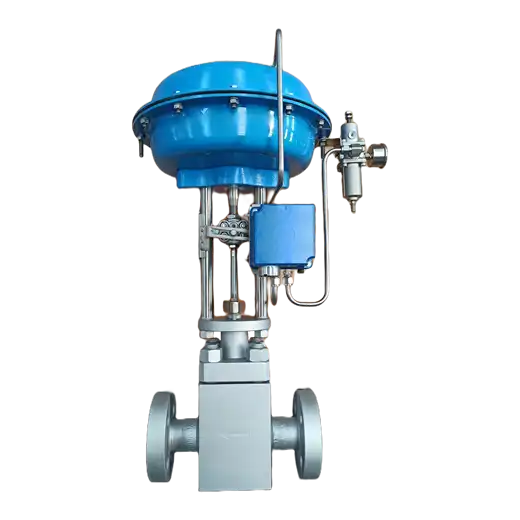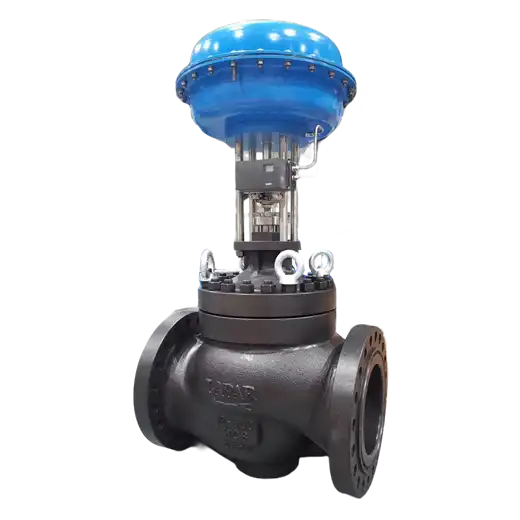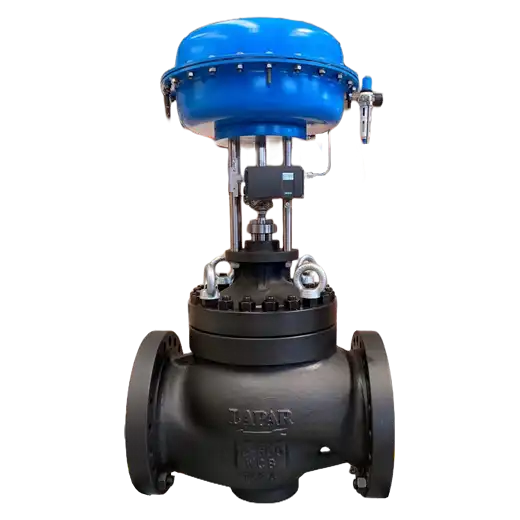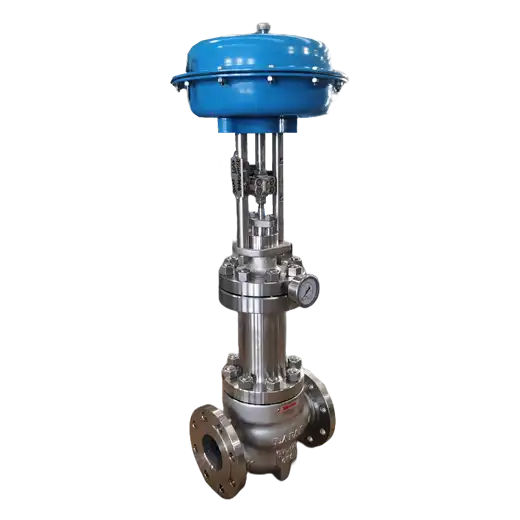
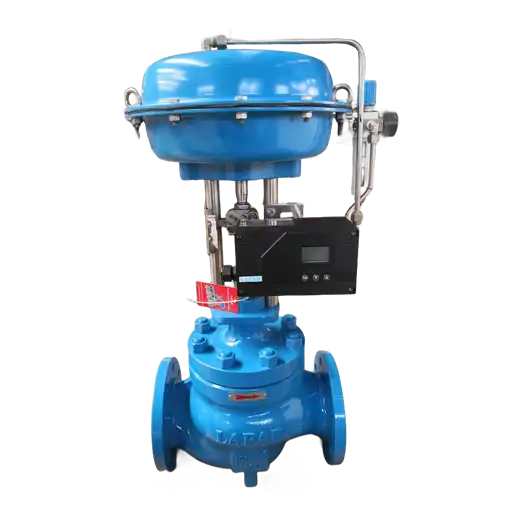
Cage Guided Single Seat Control Valve — a modulating valve with one precision sealing surface, delivering Class IV, V or VI bubble-tight shutoff in unbalanced and pressure-balanced trim for high-pressure letdown, reactor feed and cryogenic duty in DN 25 to DN 400.
Two Valve Positions, Two Different Requirements
Walk into almost any letdown station and you will find two valve positions that look interchangeable on a piping drawing but are nothing alike in service. The first takes steam or gas from a high-pressure header down to a process main and runs continuously; when it closes, a separate isolation valve downstream holds the inventory, so residual seat leakage costs nothing and the only things that matter are flow capacity, stability and actuator economy. The second position feeds a reactor, charges a batch or controls a hazardous inventory, and when it closes it must actually stop the flow — not reduce it, not slow it, but seal against several megapascals of differential with nothing downstream to back it up. The first duty suits a double seat valve. The second is what this valve exists for.
A single seat valve has one sealing surface, so the plug can be driven positively onto that seat and held there by the full force of the actuator. There is no second seat to be pulled away from as the body expands or contracts, which is why this design reaches Class VI bubble-tight closure with a soft seat and Class IV or V with a lapped metal seat — performance a double seat valve cannot physically deliver. The cage guiding then supplies what a plain stem-guided single seat valve lacks: the plug rides on a long bearing surface inside the cage, so it stays concentric with the seat through the entire stroke, resists flow-induced vibration and side loading, and does not score or gall during the thousands of partial-stroke cycles that continuous control demands.
The design splits into two trim families, and choosing between them is the single most consequential decision on the data sheet. The unbalanced trim is solid: line pressure pushes the plug onto the seat and the actuator must overcome that full thrust. It is compact, entirely immune to balance-port plugging, and the first choice for small bores and for the tightest shutoff classes. The pressure-balanced trim carries a balance port through the plug and a balance seal ring that exposes line pressure to both sides of the plug, cancelling most of the thrust mechanically. This allows a large-bore valve to be operated at high differential pressure by a reasonably sized actuator while retaining tight shutoff — the combination that a double seat valve cannot offer.
Both families share the same engineering surface in the cage. Cage window geometry sets the inherent flow characteristic, and the cage is a replaceable part, so re-characterising the valve for a revised process is a trim change rather than a valve replacement. Multi-hole, drilled-hole and multi-stage cages handle noise, cavitation and flashing by dividing the flow into small jets and stepping the pressure down progressively; micro-flow and low-Cv trims handle precision metering; bellows-sealed bonnets and live-loaded low-emission packing handle toxic and fugitive-emission-sensitive media. We specify trim type, cage configuration, seat class, metallurgy, bonnet style and actuator sizing from your process data sheet — and where the duty genuinely favours a double seat or a different valve family, we will tell you so rather than sell you the more expensive trim.
Key Features
- Class IV, V or VI Bubble-Tight Shutoff — One sealing surface driven positively onto its seat by full actuator force, with no second seat to be pulled away by differential thermal expansion. Soft-seated designs achieve Class VI bubble-tight closure per ANSI/FCI 70-2; precision-lapped metal seats achieve Class IV and V. This is the defining capability of the design and the reason it is specified wherever the valve itself is the isolation barrier.
- Two Trim Families Covering Opposite Ends of the Duty Range — Unbalanced solid trim for small bores, the tightest leakage classes and media that would plug a balance port; pressure-balanced trim with a balance port and seal ring for large bores at high differential pressure with compact actuation. Selecting correctly between them is a matter of process data, not preference.
- Long Cage Guiding Surface for Stroke Stability — The plug is guided over an extended bearing surface inside the cage rather than by the stem alone, suppressing flow-induced vibration and holding the plug concentric with the seat through full stroke. This protects the sealing surface during the frequent partial-stroke cycling that continuous control imposes.
- Interchangeable Cage Sets Flow Characteristic — Linear, equal percentage, quick opening or a custom profile is determined by cage window geometry. Changing the characteristic or resizing the trim for a revised process condition is a cage-and-plug replacement performed in the line, leaving body, bonnet, actuator and piping untouched.
- Noise, Cavitation and Flashing Trim Options — Multi-hole cages distribute the flow into numerous small jets to disperse acoustic energy; drilled-hole and multi-stage cages step the pressure down progressively to keep the fluid above its vapour pressure. This limits trim erosion and frequently removes the need for downstream silencers or acoustic lagging.
- Low-Emission and Containment Bonnet Options — Live-loaded graphite or PTFE V-ring packing systems meet ISO 15848-1 and TA-Luft fugitive-emission requirements; bellows-sealed bonnets with a safety packing backup provide zero-emission containment for toxic, carcinogenic or high-value media.
- Wide Metallurgy and Hard-Facing Range — WCB, WC6, WC9, LCB, LCC, CF8, CF8M, CF3M, duplex and super-duplex bodies; 316, 410, 17-4PH, Alloy 6 (Stellite) hard-faced or solid Stellite, Hastelloy C276 and Inconel 625 trim. Cryogenic service uses extended bonnets and austenitic trim rated to -196 °C.
- Standard ISO 5211 Actuation Interface — Pneumatic diaphragm and piston actuators with spring-return fail-open, fail-close or fail-last-position action, electric actuators and manual handwheels mount directly. Smart positioners, limit switches, solenoid valves, volume boosters, air-lock relays and air filter regulators complete the assembly.
Typical Applications
- Reactor Feed and Catalyst Injection Control
- Charging of reactants, catalyst and additives where the valve must meter precisely across a wide turndown and, when closed, must hold back the full reactor or header pressure with no downstream isolation. Tight shutoff and stable low-flow control are both mandatory here, which rules out the double seat design.
- Steam and Condensate Pressure Letdown with Isolation Duty
- Reduction from high-pressure boilers, HRSGs or steam mains to process headers where the control valve must also serve as the shutoff barrier during startup, shutdown and trips. Pressure-balanced trim lets a compact actuator hold several megapascals of differential against a tight seat.
- Hazardous and High-Value Inventory Control
- Service where leakage past a closed valve is a safety, environmental or economic loss rather than an inconvenience — toxic intermediates, flammable gases, expensive catalyst solutions and product transfers. Class V or VI shutoff and bellows-sealed containment bonnets address both the seat and the stem as leakage paths.
- Cryogenic and LNG Letdown Service
- Liquefied natural gas, nitrogen, oxygen, argon and ethylene pressure reduction and level control at temperatures down to -196 °C. Extended or cryogenic bonnets keep the packing box clear of the cold zone, and austenitic trim retains toughness without galling at temperature.
- Deaerator, Heater Drain and Level Control
- Continuous modulation of condensate and feedwater level against substantial back pressure, where the valve cycles constantly through partial stroke and needs the guiding stability and seat durability that a plain stem-guided trim cannot provide.
- Amine, Glycol and Corrosive Chemical Service
- Lean and rich amine letdown, glycol regeneration and corrosive intermediate control, with CF8M, CF3M, duplex, Alloy 20 or Hastelloy bodies and hard-faced trim selected against the specific chemistry, temperature and entrained solids.
- Hydrocarbon Processing and Refining Letdown
- Column feed, reflux and product draw, hydrocracker and hydrotreater effluent control, and hot separator level service at elevated temperature and high differential pressure. Multi-stage cage trim suppresses cavitation and flashing damage in the highest-energy positions.
- Fine Flow and Low Cv Precision Metering
- Additive dosing, sampling, seal-flush and micro-flow applications requiring very small controllable Cv with fine resolution. Micro-flow and reduced-trim cage assemblies provide stable low-flow control that an oversized standard trim cannot achieve without hunting.
These duties share a common signature that is easy to state and easy to get wrong in the field: the closed valve is load-bearing. Whether it is holding back reactor pressure, isolating a toxic inventory, sealing a cryogenic letdown or closing a steam header during a trip, the seat is the barrier and there is nothing else behind it. That requirement is what separates this valve from a double seat valve of the same size and pressure class — two valves that look identical on a piping drawing and are not interchangeable in service. It also means the specification has to be resolved as a set rather than parameter by parameter: leakage class, trim family, balance seal material, bonnet style, seat material and actuator sizing all constrain one another, and a Class VI requirement combined with a 400 °C operating temperature, for example, cannot be satisfied by any trim. We work through those interactions from your process data sheet and will recommend a different valve type where your duty does not actually need this one.
Technical Specifications
Size, Pressure and Temperature
Valve Size: DN 25 - DN 400 (NPS 1 - NPS 16); micro-flow trims from DN 15; larger sizes on request
Pressure Class: ASME Class 150 - Class 2500; DIN PN 16 - PN 400
Operating Temperature: -196 °C to +566 °C (-320 °F to +1050 °F) unbalanced trim; balanced trim limited by balance seal material — confirm per duty
Valve Style: Straight (globe) pattern, Angle pattern
Trim and Flow Control
Trim Type: Single seat plug, cage guided; unbalanced solid trim and pressure-balanced trim (balance port with balance seal ring)
Cage Configuration: Standard window cage, Multi-hole cage, Drilled-hole cage, Multi-stage cage, Micro-flow / low-Cv cage, Contoured plug
Flow Characteristic: Linear, Equal Percentage, Quick Opening, Custom characterized profile
Seat Leakage: Class IV, Class V, Class VI per ANSI/FCI 70-2 — Class VI requires soft seat and limits operating temperature accordingly
Seat Type: Metal-to-metal (lapped), Stellite hard-faced, Soft seat PTFE / PCTFE / PEEK / graphite
Turndown Capability: up to 50:1 with characterized trim and positioner; higher on micro-flow trim
Body and Trim Materials
Body Materials: WCB, WC6, WC9, LCB, LCC, CF8, CF8M, CF3, CF3M, A890 4A / 5A duplex and super-duplex, Alloy 20, F304 / F316 forgings
Trim Materials: 316 / 316L, 410, 420, 17-4PH, Alloy 6 (Stellite) hard-faced, solid Stellite, Hastelloy C276, Inconel 625, Inconel X-750
Balance Seal Material: Graphite (high temperature), PTFE, FKM, piston ring — selection sets the balanced trim temperature ceiling
Stem Material: 316, 17-4PH, 410, Inconel X-750 for high-temperature and high-cycle duty
Gaskets: Graphite, Spiral wound stainless / graphite, PTFE
Connections, Bonnet and Stem Sealing
End Connections: Flanged (ASME B16.5 / B16.47, DIN EN 1092-1), Butt-weld, Socket-weld, RTJ flanged, NPT threaded for small sizes
Bonnet Type: Standard, Extended (high temperature), Cryogenic, Finned, Bellows-sealed with safety packing backup
Stem Seal: Live-loaded graphite packing, PTFE V-ring packing, Bellows seal
Emission Control: Low-emission packing systems per ISO 15848-1 and TA-Luft
Face-to-Face: IEC 60534-3-2 / ISA 75.01, EN 558
Actuation and Instrumentation
Actuator Type: Pneumatic diaphragm, Pneumatic piston (single- and double-acting, spring return), Electric, Electro-Hydraulic, Manual handwheel
Fail Action: Fail Open, Fail Close, Fail Last Position
Topworks Interface: ISO 5211 / standard yoke mounting
Accessories: Smart positioner (4-20 mA / HART / Foundation Fieldbus / Profibus), Electro-pneumatic positioner, Limit switch box, Solenoid valve, Air filter regulator, Volume booster, Air lock relay, Position transmitter, Manual override, Locking device
Standards and Certifications
Design Standards: IEC 60534, ASME B16.34, EN 12516, API 600 / 602 where applicable
Testing Standards: ANSI/FCI 70-2 seat leakage, API 598, EN 12266-1, ISO 5208
Certifications: CE / PED 2014/68/EU, ATEX, ISO 9001, NACE MR0175 / ISO 15156, SIL-capable, TA-Luft, Fire-safe design on request
Noise Prediction: ISA S75.17 / IEC 60534-8-3 aerodynamic and hydrodynamic noise calculation on request
Service Conditions and Media
Media: Steam, Saturated and superheated steam, Boiler feedwater, Condensate, Cooling water, Process water, Natural gas, Process gas, Air, Hydrocarbons, Amine and glycol solutions, LNG and cryogenic fluids, Corrosive chemicals, Clean liquids and gases
Critical Service: Tight shutoff, High differential pressure, Cavitation control, Noise abatement, Flashing, Corrosive, Erosive, High temperature, Cryogenic, Toxic and fugitive-emission-sensitive, Low flow precision metering
Industries: Oil and Gas, Refining, Petrochemical, Chemical Processing, Power Generation, LNG and Industrial Gases, Pharmaceuticals, Pulp and Paper, Metals and Mining, Water Treatment
Design Boundaries: Balanced trim temperature is limited by the balance seal material, not by the body casting, and is always lower than the unbalanced equivalent. Balance ports are vulnerable to plugging by solids, polymerising media and heavy slurry — specify unbalanced trim or a different valve family for dirty service. Class VI bubble-tight shutoff requires a soft seat and therefore caps the maximum operating temperature. Very high Cv requirements may be met more economically by a double seat valve of the same bore.
Other Configurations: Consult our engineering team for non-standard sizes above DN 400, higher pressure classes, exotic alloys, multi-stage anti-cavitation trim, oxygen-clean or cryogenic degreased construction, fire-safe certification, or complete actuated valve assemblies with positioners and accessories.
Frequently Asked Questions
What is the difference between a single seat and a double seat control valve?
A single seat valve has one sealing surface, so the actuator drives the plug positively onto that seat and can hold it there against full differential pressure — giving Class IV, V or VI shutoff. A double seat valve has two opposing seats whose thrusts largely cancel, so it needs far less actuator force and offers higher flow capacity, but thermal expansion prevents both seats from loading at once, so it cannot exceed roughly Class III. Choose single seat when the closed valve is the isolation barrier; choose double seat when capacity and actuator economy govern and tight shutoff is provided elsewhere.
What is a pressure-balanced single seat valve and when do I need it?
A pressure-balanced trim has a balance port drilled through the plug and a balance seal ring, exposing line pressure to both sides of the plug so that most of the thrust cancels mechanically. This gives the low actuator force of a double seat valve while retaining the tight shutoff of a single seat valve. You need it for large bores or high differential pressure where an unbalanced plug would demand an impractically large actuator. Its trade-offs are a lower temperature ceiling, set by the balance seal, and vulnerability of the balance port to plugging in dirty service.
How tight can the shutoff actually be — Class IV, V or VI?
Class VI bubble-tight closure requires a soft seat in PTFE, PCTFE, PEEK or similar, which caps the maximum operating temperature, typically well below 250 °C depending on the material. Precision-lapped metal seats achieve Class V, and standard lapped or hard-faced metal seats achieve Class IV while tolerating the full temperature range of the body. Tell us the leakage class, operating temperature and differential pressure together — these three constrain each other and cannot be specified independently.
Can a pressure-balanced trim handle dirty or slurry media?
Generally no. The balance port is a small passage and will plug with solids, polymerising media, heavy slurry or crystallising fluids; once plugged, the force balance is destroyed and the actuator may be unable to move the plug. For dirty service specify unbalanced solid trim, an angle-pattern valve with a flushing connection, a cage designed for solids passage, or a different valve family altogether. Send us the medium and solids content and we will advise.
How do I choose the flow characteristic, and can it be changed later?
Choose from the installed gain of the loop rather than the valve in isolation: equal percentage for systems whose pressure drop varies substantially with flow, linear where the pressure drop is stable, quick opening for on-off or fast-acting duty. Because the characteristic is set by cage window geometry, changing it later is a cage-and-plug replacement performed in the line — the body, bonnet, actuator and piping stay in place, which makes it a routine turnaround-window task.