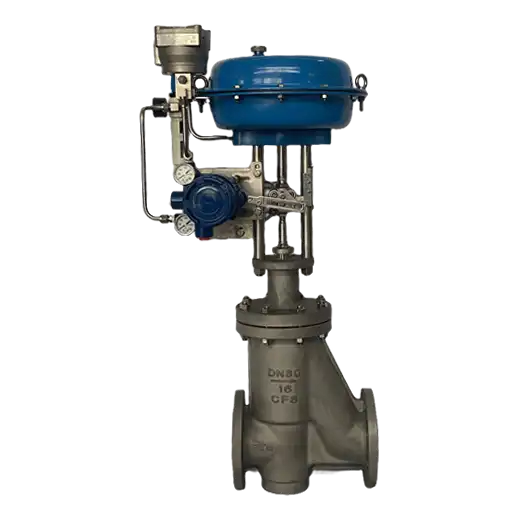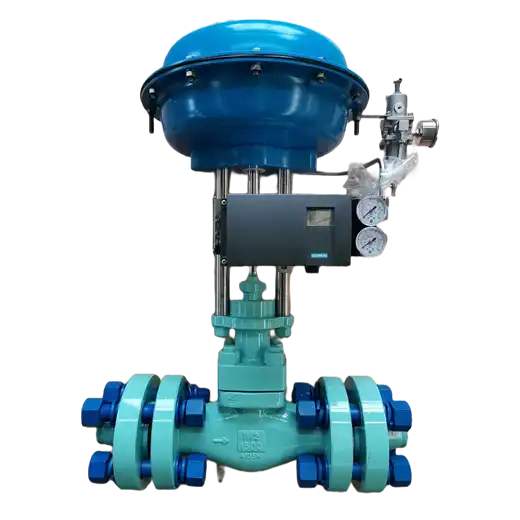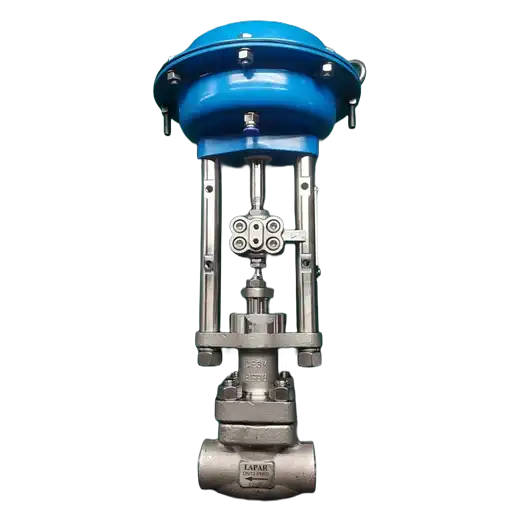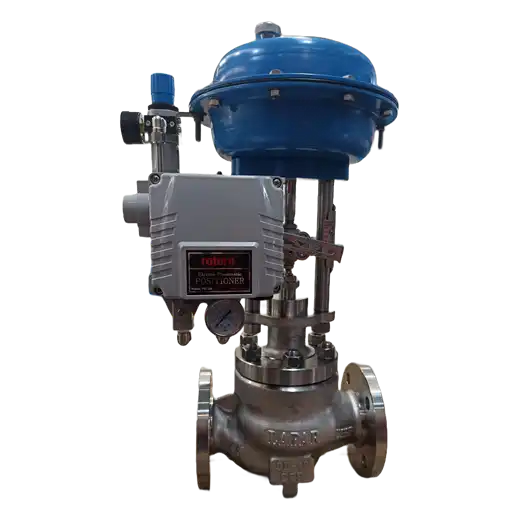
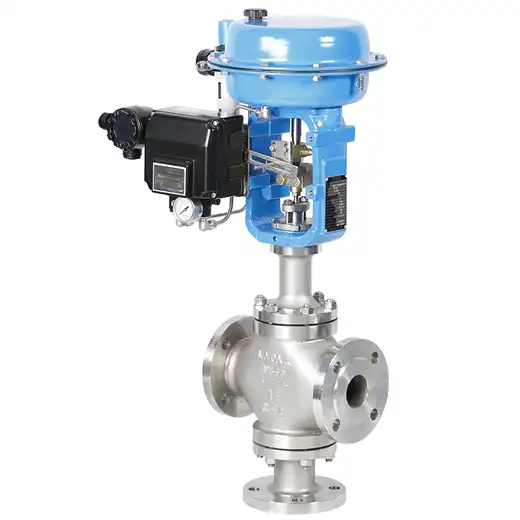
Three Way Control Valve for Mixing (Converging) and Diverting (Diverging) Flow Control.
Three way control valve mixes two incoming streams into one outlet, or diverts one incoming stream between two outlets, doing the work of two conventional control valves in a single body.
Product Description
Many process duties do not require a valve to simply throttle a line — they require it to blend or split. Temperature control on a heat exchanger is the classic case: part of the flow passes through the exchanger and part bypasses it, and the outlet temperature is set by the ratio between the two. Doing that with two separate valves means two bodies, two actuators, twice the pipework, twice the leak paths, and a control strategy that has to coordinate both positions. A three way valve collapses that into one trim with one actuator and one control signal.
The two configurations are not interchangeable. A mixing (converging) valve has two inlets and one outlet; a diverting (diverging) valve has one inlet and two outlets. The internal trim geometry and the pressure balance across the plug differ between them, and the direction of plug loading changes accordingly. Selecting the wrong configuration does not merely degrade performance — it can produce a plug that is loaded in the wrong direction and behaves unpredictably. This is why the configuration must be stated at the specification stage rather than assumed from the piping layout.
Inside the body, a double-seated or cage-guided plug assembly proportioned flow between the two paths as it travels. Because the plug must seat against two seats, shutoff on a three way valve is inherently different from a single-seat valve: leakage classification per ANSI/FCI 70-2 is achievable, but the tightest classes are not realistic on both ports simultaneously, and the specification should state which port needs the tighter shutoff. Where one branch must be dead-tight, the usual answer is a three way valve for proportioning plus a separate isolation on the critical branch. Capacity and sizing follow the IEC 60534 series, with each port calculated on its own Cv rather than treating the valve as a single restriction.
Key Features
- Mixing or diverting configuration: purpose-built converging or diverging trim geometry, specified to match the actual flow path rather than adapted at installation.
- One valve instead of two: a single body, actuator and positioner replaces a two-valve arrangement, reducing pipework, supports, leak paths and control complexity.
- Cage-guided plug stability: cage guiding keeps the plug centered through the full travel, which matters because three way trim is loaded from both directions.
- Independently calculated port capacity: each port is sized on its own flow coefficient and differential, so proportioning stays predictable across the travel range.
- Defined leakage classification: seat leakage classified per ANSI/FCI 70-2, with the tighter class assigned to the port where it matters.
- Compatible with standard automation: accepts pneumatic, electric or hydraulic actuators and conventional positioners, with no special control hardware required.
Typical Applications
- Heat exchanger bypass temperature control — proportioning flow between the exchanger and the bypass to hold outlet temperature without throttling total flow.
- Reactor jacket and cooling water blending — mixing hot and cold streams to track a temperature setpoint through batch heating and cooling phases.
- Fuel oil and viscous fluid diverting — switching or proportioning flow between recirculation and burner supply.
- Process stream splitting to two destinations — diverting a stream between two units, two tanks or run and standby paths.
- Blending two streams to a target ratio — dilution, additive blending and ratio control where one controlled device is preferred over two coordinated valves.
A three way valve is a topology decision before it is a hardware decision. The first question is whether the duty is mixing or diverting, because that determines the trim, the plug loading and the achievable shutoff — and getting it wrong cannot be corrected with a positioner or a tuning change. We confirm the configuration against your piping arrangement and process intent, calculate each port independently, and state explicitly which port carries the tighter leakage requirement. The result is one controlled device doing the work of two, with proportioning behavior you can predict.
Technical Specifications
| Valve Size | NPS 1/2 – NPS 12 / DN 15 – DN 300 |
|---|---|
| Pressure Class | ASME Class 150 to 600; DIN PN16, PN25, PN40, PN63, PN100 |
| Operating Temperature | -29 to +425 °C / -20 to +800 °F |
| Process Connection | Flanged, Butt Weld, NPT Threaded, Socket Weld, Custom |
| Body Style | Three Way Globe (Mixing / Converging, Diverting / Diverging) |
| Bonnet | Standard, High Temperature (Finned / Extension), Cryogenic |
| Stem Seal | Adjustable Packing (bellows seal available) |
| Trim | Cage-guided or double-seated plug; characterized for linear proportioning |
| Seat Leakage | Class III, Class IV per ANSI/FCI 70-2 (class assigned per port) |
| Flow Characteristics | Linear, Equal Percentage, Custom |
| Critical Service | Mixing, Diverting, Temperature Control, Bypass, General Service |
| Actuator | Pneumatic Diaphragm, Piston, Electric, Hydraulic |
| Accessories | Positioner, Position Transmitter, Limit Switch, Solenoid Valve, Air Lock Relay, Air Filter Regulator |
| Certifications | ANSI/ISA, ASME, NACE, PED, ATEX, SIL capable |
| Media | Liquids, Steam, Gases, Thermal Fluids |
| Industries | Chemical & Petrochemical, Power, HVAC & District Energy, Oil & Gas, Food & Beverage, Pulp & Paper |
Frequently Asked Questions
What is the difference between a mixing and a diverting three way valve?
A mixing valve has two inlets and one outlet, blending two streams into a common discharge. A diverting valve has one inlet and two outlets, splitting or proportioning one stream between two paths. The internal trim geometry and plug loading differ, so the configuration must be specified up front rather than chosen from the piping at installation.
Can one three way valve do both mixing and diverting?
Some designs are offered as convertible, but most are built specifically for one flow path. Because plug loading direction differs between the two duties, a valve installed in the unintended configuration will not proportion predictably. Confirm the required duty before ordering.
Why not use two separate control valves?
Two valves work, but they cost more to buy, install, support and automate, and they require the control system to coordinate two positions. A three way valve does the proportioning in one trim with one actuator, and removes one set of piping joints and potential leak paths.
How tight is the shutoff on a three way valve?
Tighter than a throttling arrangement but not as tight as a single-seat valve, because the plug must relate to two seats. Leakage is classified per ANSI/FCI 70-2, and the tighter class should be assigned to the port where it actually matters. Where one branch must be dead-tight, add a separate isolation on that branch.
How is a three way valve sized?
Each port is calculated independently on its own required flow coefficient and differential, rather than sizing the valve as one restriction. Capacity follows the IEC 60534 series. Supplying both port conditions gives a more accurate selection than a single total-flow figure.