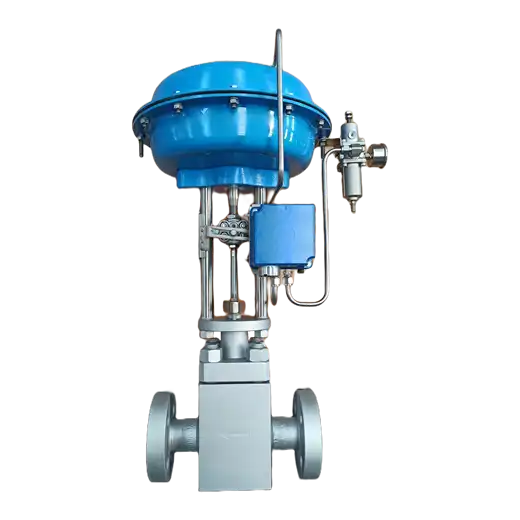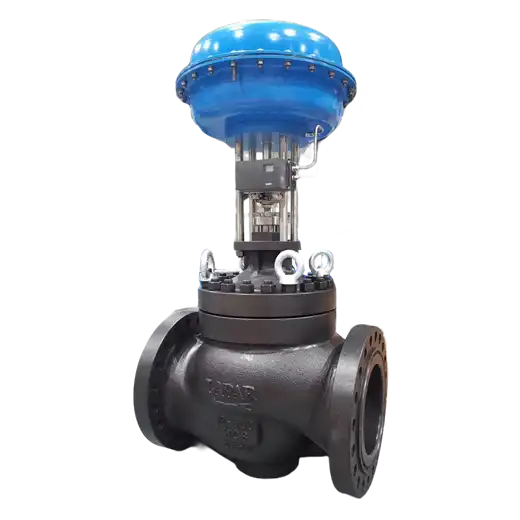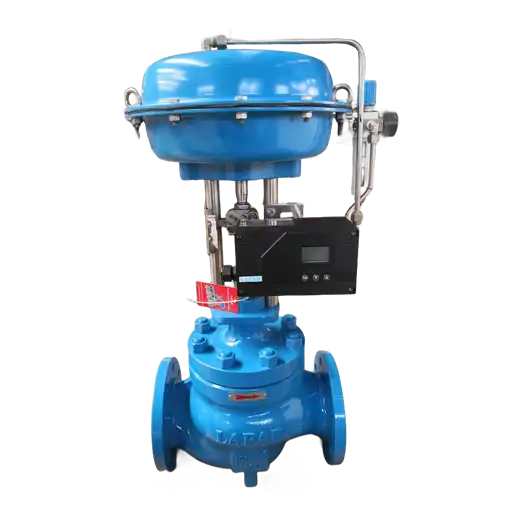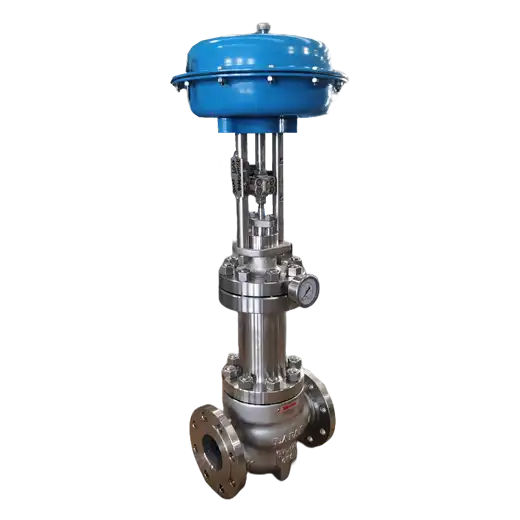
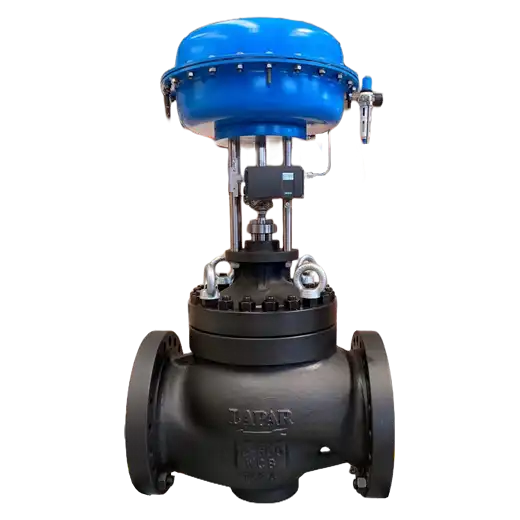
Pressure balanced cage type control valve uses a balanced plug assembly to cancel most of the differential pressure thrust acting on the plug, allowing a high differential to be controlled by a practical actuator size instead of an impractically large one.
Product Description
In an unbalanced single-seat valve, the full differential acts across the plug area. As line pressure and differential rise, the force the actuator must overcome rises with them — and eventually the required thrust dictates a larger actuator, a stronger spring range, or a different valve architecture entirely. This is the point at which a specification that was adequate at lower pressure stops being buildable: not because the body cannot take the pressure, but because the actuator cannot move the plug.
A balanced trim changes that. Pressure is admitted to both sides of the plug through ports or passages in the plug itself, so the differential acts on opposing areas and the net thrust is largely cancelled. The result is a plug whose required operating force is far less sensitive to differential, which means a given actuator can handle a much higher ΔP, response to small signal changes improves, and the valve can be built with a smaller, less expensive and faster-acting actuator. The balance element is a seal — a balancing seal ring, piston ring or seal cage — that separates the two pressure zones while allowing the plug to move, and its condition determines how well the balance holds over time.
The trade-off is leakage, and it should be stated plainly. A balanced plug requires a sliding or compliant seal between two pressure zones, and that seal path is also a leakage path. Balanced trims therefore typically do not reach the tightest leakage classes available to an unbalanced single-seat design; Class IV per ANSI/FCI 70-2 is the common expectation, with tighter classes dependent on the balance seal design and the shutoff requirement. Where a service demands both high differential and Class V or Class VI shutoff, that conflict has to be resolved deliberately — sometimes by accepting a larger actuator on an unbalanced design, sometimes by adding separate isolation. Capacity and thrust calculations follow the IEC 60534 series, and cage guiding keeps the plug concentric under the side loads that high differential produces.
Key Features
- Balanced plug geometry: pressure is admitted to both sides of the plug, so differential thrust is largely cancelled rather than transmitted to the actuator.
- Higher differential on the same actuator: because required thrust is far less sensitive to ΔP, a given actuator handles a significantly higher differential than it could on an unbalanced trim.
- Cage-guided plug stability: the cage maintains concentric alignment under the side loading that high differential generates, protecting against uneven wear and erratic travel.
- Improved response with smaller actuation: reduced thrust allows a smaller actuator with faster stroking and better resolution on small signal changes.
- Defined leakage performance: seat leakage classified per ANSI/FCI 70-2, with the balance seal path acknowledged as a leakage consideration.
- Full characterizing range: cage porting is selected for linear or equal-percentage characteristic, so balancing does not cost controllability.
Typical Applications
- High differential liquid and gas letdown — where ΔP would demand an impractically large actuator on an unbalanced design.
- Boiler feedwater and condensate service — high pressure drop duties where thrust and response both matter.
- Compressor antisurge and recycle control — fast, high differential modulation where stroking speed and thrust are both critical.
- Hydrocarbon and refinery process letdown — high differential services across separators, strippers and fractionation.
- Steam conditioning and turbine bypass auxiliary duties — within the temperature and differential envelope of the trim.
Balanced trim is a solution to a force problem, and like every such solution it moves the constraint somewhere else — in this case, into the leakage path and the balance seal. That is a worthwhile trade on high differential service, and a poor one where tight shutoff is the governing requirement. We calculate the actual unbalanced thrust on your differential, confirm whether the balanced design genuinely reduces your actuator size, and state the leakage class the balance seal will realistically hold. Where tight shutoff governs, we will tell you to take the larger actuator instead.
Technical Specifications
| Valve Size | NPS 1 – NPS 16 / DN 25 – DN 400 |
|---|---|
| Pressure Class | ASME Class 150 to 900; DIN PN16, PN25, PN40, PN63, PN100 |
| Operating Temperature | -29 to +425 °C / -20 to +800 °F (balance seal material dependent) |
| Process Connection | Flanged, Butt Weld, Socket Weld, Custom |
| Body Style | Straight (Globe), Angle |
| Bonnet | Standard, High Temperature (Finned / Extension), Cryogenic |
| Stem Seal | Adjustable Packing (bellows seal available) |
| Trim | Balanced plug with balancing seal ring or piston ring in a cage-guided assembly |
| Seat Leakage | Class IV per ANSI/FCI 70-2 (tighter classes dependent on balance seal design) |
| Flow Characteristics | Linear, Equal Percentage, Quick Open, Custom |
| Critical Service | High Differential, Antisurge, Letdown, Boiler Feedwater, General Service |
| Actuator | Pneumatic Diaphragm, Piston, Electric, Hydraulic |
| Accessories | Positioner, Position Transmitter, Limit Switch, Solenoid Valve, Volume Booster, Air Lock Relay, Air Filter Regulator |
| Certifications | ANSI/ISA, ASME, NACE, PED, ATEX, SIL capable |
| Media | Liquids, Gases, Steam, Hydrocarbons |
| Industries | Oil & Gas, Refining, Power, Chemical & Petrochemical, Industrial Gases, Metals & Mining |
Frequently Asked Questions
What does "pressure balanced" actually mean?
Pressure is admitted to both sides of the plug through passages in the plug itself, so the differential acts on opposing areas and the net thrust is largely cancelled. The actuator no longer has to overcome the full differential across the plug area, which is what makes a smaller actuator feasible.
When should I specify a balanced trim instead of an unbalanced one?
When the differential across an unbalanced plug would require an impractically large actuator, or when you need faster stroking and better resolution than a large actuator can deliver. At low differentials the added complexity of the balance seal buys nothing.
What is the downside of balanced trim?
Leakage. The balance seal that separates the two pressure zones is also a leakage path, so balanced trims typically do not reach the tightest leakage classes available to an unbalanced single-seat design. Class IV per ANSI/FCI 70-2 is the common expectation.
Can I get high differential and Class VI shutoff in one valve?
Usually not in the same trim. The two requirements pull against each other: balancing reduces thrust but adds a leakage path. Where both are mandatory, the common answers are a larger actuator on an unbalanced design, or a balanced control valve plus separate isolation on the critical line.
Does the balance seal wear out?
Yes. The balancing seal is a wearing component, and its condition determines how well the balance holds over time. It should be treated as a maintenance item on high-cycling service, and it is one of the reasons tight leakage classes are not claimed indefinitely on balanced trims.