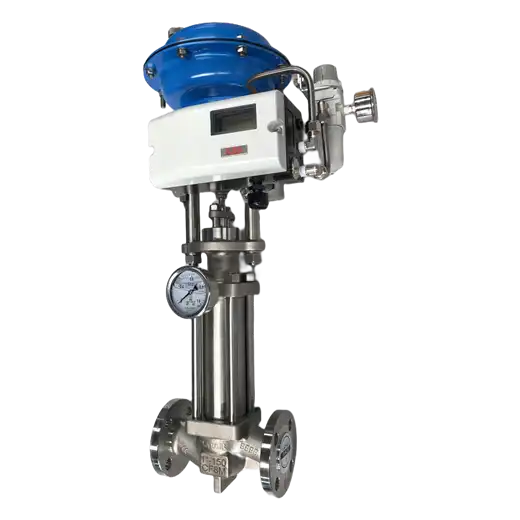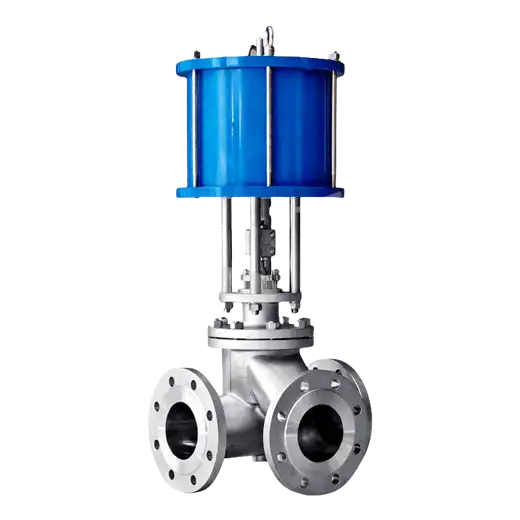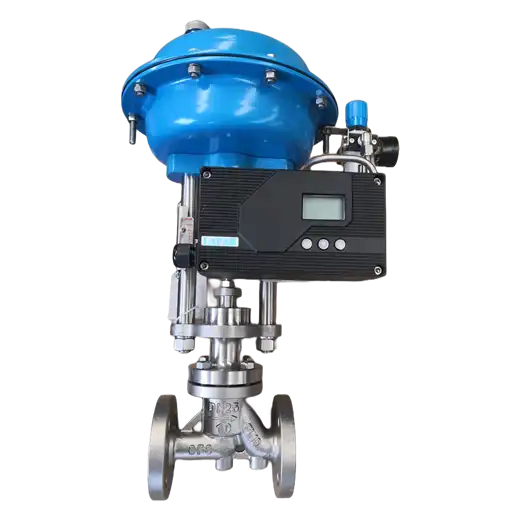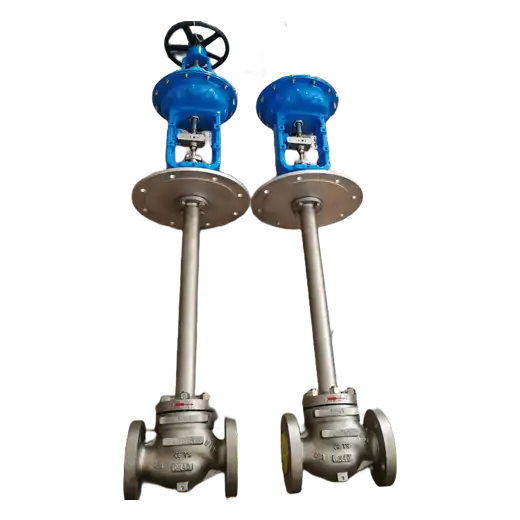
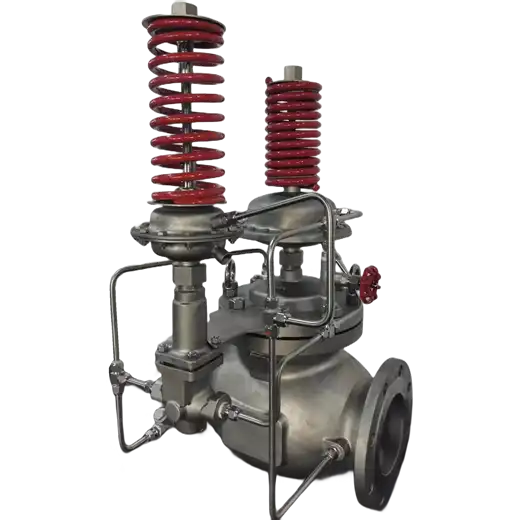
Pilot Actuated Main Valve for Accurate Pressure Control Without External Power.
Product Introduction
A pilot operated control valve uses a small pilot regulator to sense process pressure and control the loading on a diaphragm-actuated main valve, delivering accurate pressure control at full line capacity without any external power supply.
Product Description
A direct-acting self-operated regulator has a structural limitation: the same diaphragm that senses pressure must also produce enough force to position the plug. As valve size and pressure rise, that diaphragm has to grow, and a larger sensing element is inherently less sensitive. The practical result is that direct-acting regulators lose accuracy and become bulky at larger sizes.
Pilot operation separates those two functions. A small, sensitive pilot regulator senses the process pressure and controls the pressure loading on the main valve's actuating chamber. The main diaphragm then does only what it is good at — producing large force — while the pilot does what it is good at — sensing accurately. Because the pilot handles a small flow and the main valve handles the full line flow, the combination scales: accuracy does not degrade with valve size, and the assembly stays more compact than a direct-acting regulator of equivalent capacity.
The architecture also makes the control function configurable by changing the pilot rather than the valve. Pressure reducing, back pressure, differential pressure, relief, unloading and surge control functions are all achieved with pilot selection and sensing arrangement on the same main valve body, which is why this design is common on large pressure reducing stations, back pressure control on separators, and unloading duties. The trade-offs are real and should be stated: the pilot and its sensing lines are additional components that require clean fluid and correct installation, a pilot circuit is more sensitive to dirty or fouling service than a direct-acting regulator, and setpoint is mechanical rather than remote. Where remote setpoint, recording or very tight control is required, an instrumented control loop is the correct answer.
Key Features
- Accuracy that scales with size: the pilot senses and the main diaphragm actuates, so control accuracy does not degrade as valve size and pressure increase.
- Full line capacity: the main valve handles the process flow while the pilot handles only a small control flow, keeping the assembly compact for its capacity.
- Function set by the pilot: pressure reducing, back pressure, differential, relief, unloading and surge functions are configured through pilot selection on the same main valve.
- No external power: energized entirely by the process fluid — no instrument air, wiring or control system.
- Tight proportional band: pilot sensing gives noticeably better accuracy than a direct-acting regulator at comparable sizes.
- Configurable fail action: the pilot and spring arrangement determine the response to loss of sensing pressure, specified to suit the process.
Typical Applications
- Large pressure reducing stations — main pressure reduction where capacity and accuracy are both required.
- Separator and vessel back pressure control — holding upstream pressure on production separators and scrubbers.
- Pump and compressor unloading and recirculation — relieving or bypassing flow to protect rotating equipment.
- Surge and relief control — pressure limiting functions configured through pilot selection.
- Transmission, distribution and storage pressure control — gas and liquid service where no power is available at the point of control.
The decision between a pilot operated valve and a direct-acting regulator is a decision about size and accuracy together. At small sizes and moderate accuracy requirements, a direct-acting regulator is simpler and has fewer components to foul. As size rises, or as the required proportional band tightens, the pilot architecture wins — and it wins by a wider margin the larger the valve gets. We size the main valve for your flow and differential, select the pilot for the control function and accuracy you need, and confirm the sensing arrangement against the cleanliness of your fluid, since a pilot circuit on dirty service is the most common source of trouble in this design.
Technical Specifications
| Valve Size | NPS 1 – NPS 16 / DN 25 – DN 400 |
|---|---|
| Pressure Class | ASME Class 150 to 600; DIN PN16, PN25, PN40, PN63, PN100 |
| Operating Temperature | -29 to +350 °C / -20 to +660 °F (element material dependent) |
| Control Function | Pressure Reducing, Back Pressure, Differential Pressure, Relief, Unloading, Surge Control |
| Setpoint Range | 0.01~2.0MPa |
| Actuation | Pilot-loaded diaphragm or piston main valve actuator |
| Power Requirement | None — energized by process fluid |
| Process Connection | Flanged, Butt Weld, Socket Weld, Custom |
| Body Style | Straight (Globe) |
| Sensing Arrangement | External impulse lines to pilot; internal sensing on request |
| Seat Leakage | Class IV per ANSI/FCI 70-2 (soft seat options on request) |
| Critical Service | Pressure Reducing, Back Pressure, Relief, Unloading, Surge Control, No Air Supply |
| Body Materials | Carbon Steel, Stainless Steel, Alloy on request |
| Certifications | ASME, PED, ATEX (no electrical components) |
| Media | Gases, Steam, Liquids, Natural Gas, Hydrocarbons, Water |
| Industries | Oil & Gas, Refining, Chemical & Petrochemical, Power, Water & Wastewater, Industrial Gases |
Frequently Asked Questions
How is this different from a self-operated pressure regulator?
Both use process energy and no external power. A direct-acting regulator uses one diaphragm to both sense and actuate, so accuracy degrades as size grows. A pilot operated valve separates the two: a small sensitive pilot senses and controls the loading on the main actuator, so accuracy holds up at much larger sizes.
When should I choose pilot operation over direct acting?
When valve size is large, when the required proportional band is tight, or when the assembly would otherwise be bulky. At small sizes with modest accuracy requirements, a direct-acting regulator is simpler and has fewer components to foul.
Can one main valve serve different control functions?
Yes, largely. Pressure reducing, back pressure, differential, relief, unloading and surge functions are configured through pilot selection and sensing arrangement on the same main valve body.
Does the pilot need clean fluid?
Yes. The pilot and its sensing lines handle small passages and are more sensitive to dirt and fouling than a direct-acting regulator. On dirty service, filtration or a different architecture should be considered.
Does it require any utilities?
None. No instrument air, electrical supply or control system. Setpoint is adjusted mechanically at the pilot.
Resources
Data Sheets:
Manuals: IOM
Product Photos: