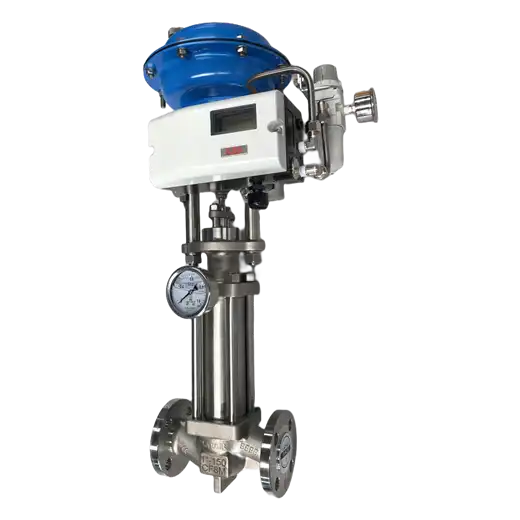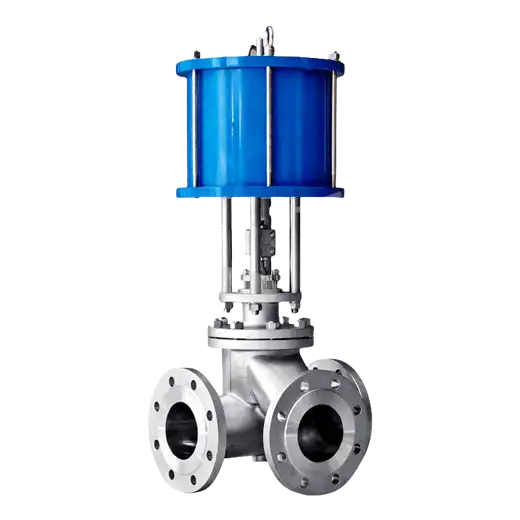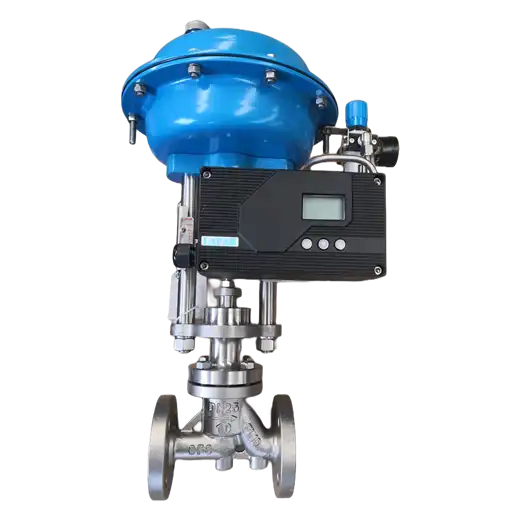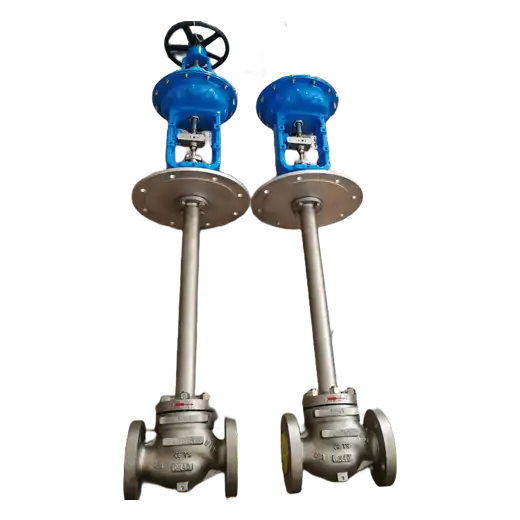
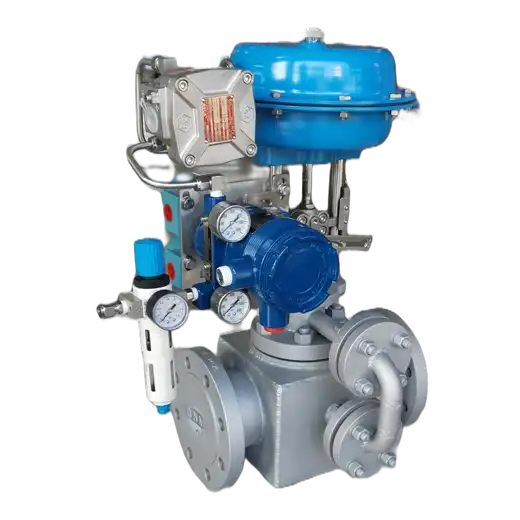
Steam/Hot Oil Heating jacketed control valve surrounds the body with a heating jacket so the process fluid stays above its solidification or crystallization temperature, keeping a fluid that would otherwise freeze, thicken or crystallize in the body both flowing and controllable.
Product Description
Some fluids only behave as fluids within a narrow temperature band. Molten sulfur, bitumen and asphalt, molten salts, polymer melts, chocolate and fat blends, molasses, waxes and a long list of concentrated solutions all become unhandleable — or simply solid — if they cool past a certain point. A control valve is the worst place for that to happen: it is a restriction with small clearances between moving parts, it is usually the coldest component in a line because of its mass and exposed surface, and once product solidifies inside it, the valve does not merely stop controlling, it stops moving.
The usual response is heat tracing plus insulation, which helps but leaves the valve body as the cold spot and the plug and seat as the first place to seize. A jacketed valve solves it at the component level. A fabricated jacket surrounds the body and, in a fully jacketed design, the bonnet and extensions as well. Steam or a thermal fluid circulates through the jacket, and because the heat is applied across the whole pressure boundary rather than along a traced line, the body, the seating area and the stem region are all held above the critical temperature. The jacket is a fabricated pressure-retaining component in its own right, so it is specified with its own design pressure, temperature and connection arrangement rather than treated as an accessory.
Selection centers on three things. The heating medium must be hot enough to hold the process above its critical temperature but not so hot that it degrades or cokes the product — which is why thermal fluid is often preferred over steam on higher-temperature duty. The jacketing coverage has to include every region where the fluid can stagnate, which means deciding between body-only and full body-and-bonnet coverage at specification. And the trim and clearance design has to suit a viscous fluid: flow characteristics and capacity are calculated on the actual viscosity rather than on a water-equivalent basis, and the trim is selected to avoid the narrow passages that viscous and crystallizing fluids will bridge. Sizing follows the IEC 60534 series with viscosity correction applied.
Key Features
- Full or partial jacket coverage: fabricated jacket over the body, with full body and bonnet coverage available where stem-region solidification is a risk.
- Steam or thermal fluid heating: the medium is selected to hold the process above its critical temperature without degrading or coking the product.
- Jacket rated as a pressure component: the jacket carries its own design pressure, temperature and connections, and is specified accordingly rather than treated as an accessory.
- Viscosity-corrected sizing: capacity and characteristic are calculated on the actual fluid viscosity, not on a water-equivalent basis.
- Trim geometry suited to viscous and crystallizing fluids: passage selection avoids the narrow clearances that viscous fluids bridge and crystallizing products block.
- Insulation-ready construction: the jacket provides the heating function, and the valve is prepared for external insulation to reduce heat loss and protect personnel.
Typical Applications
- Molten sulfur and sulfur recovery — the classic jacketing duty, where solidification occurs only slightly above ambient and blocks valves rapidly.
- Bitumen, asphalt and heavy residue — high viscosity fluids that require sustained heat to remain pumpable and controllable.
- Molten salt and heat transfer loops — high-temperature fluids where heat loss causes freeze-up in the line and the valve.
- Polymer melts and resin service — where cooling causes solidification and degraded product quality.
- Food, fat and confectionery fluids — chocolate, fat blends and molasses where temperature is a product quality parameter as well as a flow requirement.
Jacketed valves fail in a specific and avoidable way: the jacket is specified, but the temperature band is not. If the heating medium is too cool, the product solidifies; if it is too hot, the product degrades or cokes and the damage is slower but more expensive. We confirm the process fluid's pour point, crystallization temperature and maximum allowable temperature, match the heating medium and jacket coverage to that band, and size the trim on your actual viscosity. The result is a valve that still strokes after a shutdown, which is the only performance measure that matters on this duty.
Technical Specifications
| Valve Size | NPS 1 – NPS 8 / DN 25 – DN 200 |
|---|---|
| Pressure Class | ASME Class 150 to 600; DIN PN16, PN25, PN40, PN63 |
| Operating Temperature | Process dependent; jacket designed to the specified heating medium temperature |
| Jacket Design Pressure | PN16, Class 150, custom |
| Heating Medium | Steam, Thermal Oil, Hot Water, Glycol |
| Jacket Coverage | Body Only; Body and Bonnet (full jacketing) |
| Jacket Connections | Flanged, NPT Threaded, Socket Weld |
| Process Connection | Flanged, Butt Weld, Custom |
| Body Style | Straight (Globe), Angle |
| Bonnet | Standard, Extended, Jacketed |
| Stem Seal | Adjustable Packing (high-temperature packing set) |
| Trim | Full-area trim for viscous service; characterized for linear or equal-percentage control |
| Seat Leakage | Class IV, Class V per ANSI/FCI 70-2 |
| Flow Characteristics | Linear, Equal Percentage, Custom |
| Critical Service | Viscous Fluid, Crystallizing Fluid, High Temperature, Solidification Risk, Steam Conditioning |
| Actuator | Pneumatic Diaphragm, Piston, Electric |
| Accessories | Positioner, Position Transmitter, Limit Switch, Solenoid Valve, Air Filter Regulator |
| Certifications | ANSI/ISA, ASME, PED, ATEX |
| Media | Molten Sulfur, Bitumen, Molten Salt, Polymer Melts, Viscous Liquids |
| Industries | Sulfur Recovery, Refining, Petrochemical, Chemical, Fertilizer, Food & Beverage, Polymers |
Frequently Asked Questions
When is a jacketed valve necessary instead of heat tracing?
When the valve body itself would become the cold spot in the line. Tracing and insulation help the pipe, but the valve has more mass, more exposed surface and tighter internal clearances. If the fluid can solidify, crystallize or become unpumpable at the valve, jacketing is the correct answer.
Should I use steam or thermal fluid in the jacket?
It depends on the temperature band of the process fluid. Steam is simple and effective where its saturation temperature is appropriate. Where a higher temperature is needed, or where precise temperature control matters to avoid degrading or coking the product, a thermal fluid loop is generally preferred.
Does the jacket need to cover the bonnet as well?
If the fluid can stagnate and solidify in the stem region, yes. Full body and bonnet jacketing removes that risk. Where only the body is at risk, body-only coverage is sufficient and less costly.
How is the valve sized for a viscous fluid?
Capacity and flow characteristic are calculated on the actual fluid viscosity rather than a water-equivalent basis, following the IEC 60534 series with viscosity correction applied. Sizing a viscous service as if it were water is a common source of undersized valves.
Is the jacket itself pressure-rated?
Yes. The jacket is a fabricated pressure-retaining component with its own design pressure, temperature and connection arrangement, and it must be specified as such — not treated as an accessory to the valve.
Resources
Data Sheets:
Manuals: IOM
Product Photos: