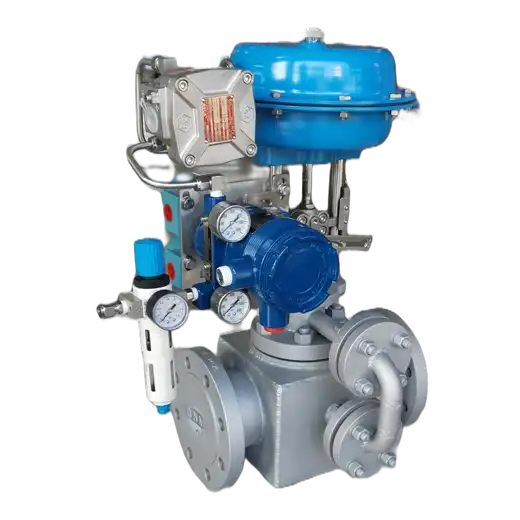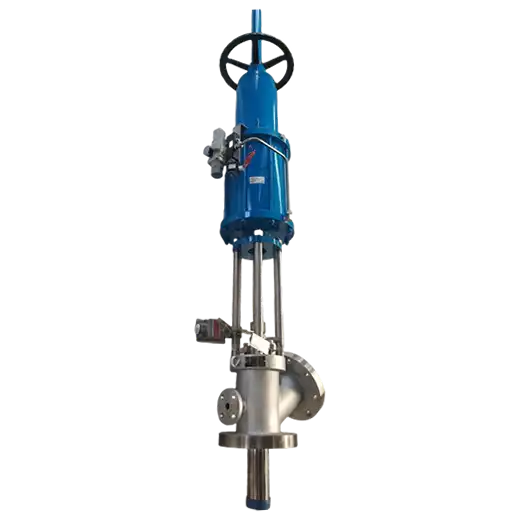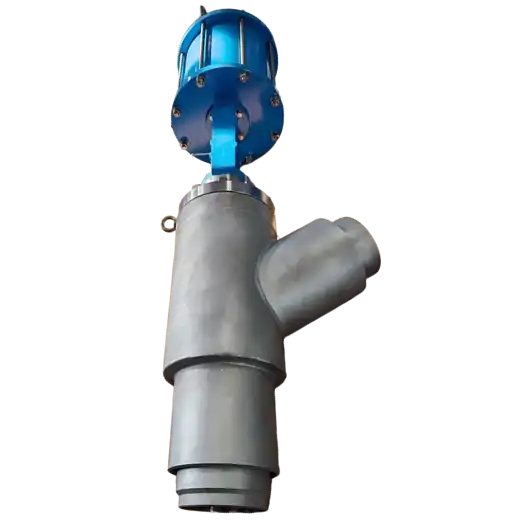
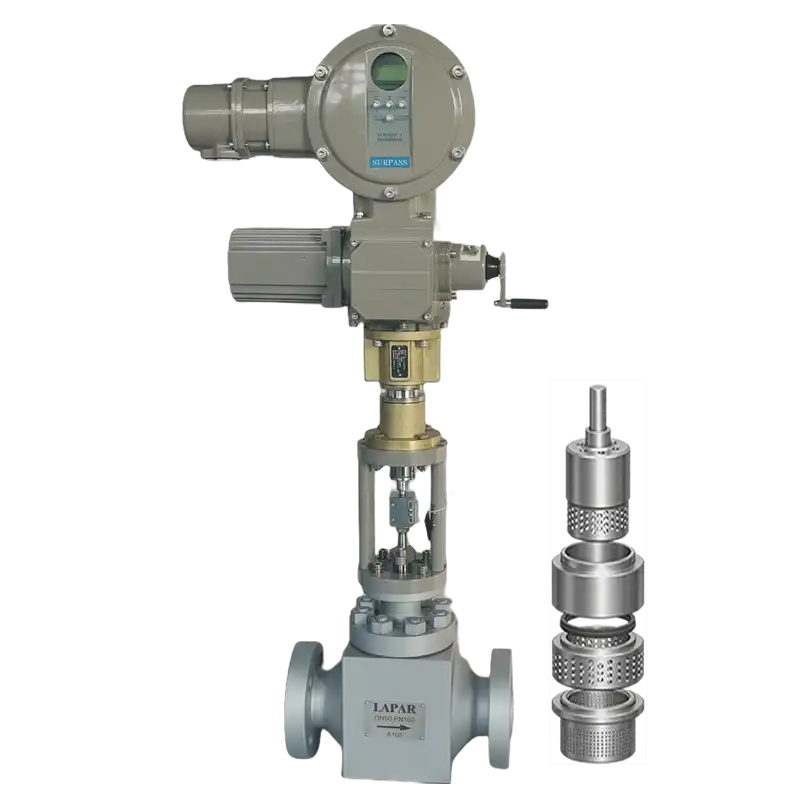
A multi-stage trim anti-cavitation control valve divides an extreme pressure drop into a sequence of engineered intermediate steps, holding fluid velocity and static pressure at every stage below the threshold where cavitation, flashing and destructive noise begin.
Product description
In high-pressure-drop service, a conventional single-stage control valve concentrates the entire differential across one restriction. Pressure at the vena contracta can fall below the fluid’s vapour pressure, forming vapour bubbles that collapse violently the moment pressure recovers downstream. That collapse — cavitation — pits trim surfaces, erodes the plug and seat, generates broadband noise, shakes connected piping, and routinely destroys a standard cage-and-plug assembly inside a single operating cycle. Flashing is a different but equally destructive failure mode: when downstream pressure stays below vapour pressure, the flow becomes two-phase and accelerates to velocities that scour metal away.
A multi-stage trim anti-cavitation control valve removes that single-point energy release. The trim is built as a series of discrete restriction elements — labyrinth disks, stacked orifice plates, drilled cages and diffuser passages — that split the total ΔP into a controlled number of intermediate steps. Each stage dissipates only a fraction of the available energy, and the interstage recovery volume lets static pressure rebound before the fluid enters the next restriction. By keeping local static pressure above vapour pressure throughout the flow path, the valve prevents bubble formation rather than merely surviving it, while the reduced stage velocity keeps hydrodynamic noise and erosive wear within manageable limits.
Because staging is engineered rather than empirical, stage count, passage geometry and interstage volume are matched to the real thermodynamics of the service: inlet pressure, design ΔP, fluid properties, temperature, and the full range of operating cases including start-up, turndown and upset. Capacity and noise prediction reference established industry methods (the IEC 60534 series for sizing and hydrodynamic noise, ISA RP75.23 for cavitation evaluation), and trim geometry is selected from proven configurations instead of extrapolating water-based rules of thumb. The result is stable, repeatable modulation across a wide turndown range, predictable acoustic performance, and a service life measured in years rather than weeks.
Key features
- Engineered stage-by-stage pressure letdown: total ΔP is budgeted across a defined number of discrete stages, so no single restriction ever sees the full differential.
- Cavitation and flashing suppression: local static pressure is held above vapour pressure at every point in the trim, preventing bubble formation instead of absorbing its consequences.
- Acoustic and vibration control: stage velocity limiting plus interstage damping disrupt coherent turbulence, with noise predicted per IEC 60534-8-4 — frequently removing the need for downstream silencers or acoustic lagging.
- Erosion-resistant materials and geometries: hardened and coated trim options, tortuous-path passages and diffuser recovery sections withstand abrasive and two-phase duty.
- Modular, re-stagable cage assembly: individual stage modules can be added, removed or reconfigured during turnarounds to match changed process conditions such as feedstock swing, catalyst aging or load reduction.
- Full modulating rangeability with standard automation: compatible with pneumatic, electric, hydraulic and electro-hydraulic actuators, with linear, equal-percentage or custom characteristics and seat leakage classified per ANSI/FCI 70-2.
Typical applications
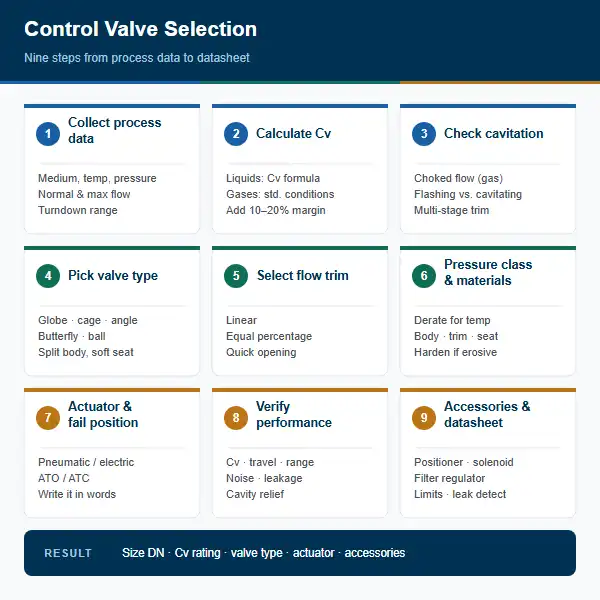
Selecting a multi-stage anti-cavitation valve is a process problem, not a catalogue exercise. Every letdown point has its own thermodynamic envelope, and a trim that is correct at design flow can still cavitate at minimum flow or during an upset. We validate stage count and trim geometry against your actual operating cases — not a single design point — so the valve that ships is the valve that holds up. The outcome is a letdown point converted from a recurring maintenance liability into a predictable, long-life asset that protects process stability, personnel safety and operating continuity.
Technical specifications
| Specification | Range / options |
|---|---|
| Valve size | NPS 2 – NPS 16 / DN 50 – DN 400 |
| Pressure class | ASME Class 600 to 2500; DIN PN100, PN160, PN250 |
| Operating temperature | −29 to +590 °C / −20 to +1100 °F |
| Process connection | Flanged (RF / RTJ), Butt Weld, Grayloc Hub, Custom |
| Body style | Straight (Globe), Angle, Y-Pattern, Fabricated |
| Bonnet | Standard, High Temperature (Finned / Extension), Cryogenic |
| Stem seal | Adjustable Packing (bellows seal available) |
| Trim type | Multi-stage labyrinth disk, stacked orifice plate, drilled cage and diffuser configurations |
| Stages | 3 to 12+ discrete stages, engineered per service thermodynamics |
| Seat leakage | Class IV, Class V per ANSI/FCI 70-2 |
| Flow characteristics | Linear, Equal Percentage, Quick Open, Custom |
| Critical service | Anti-Cavitation, Flashing, High Pressure Drop, Noise Abatement, Erosive, Outgassing, Dirty Service |
| Actuator | Pneumatic, Electric, Hydraulic, Electro-Hydraulic |
| Accessories | Pneumatic / Electro-Pneumatic Positioner, Limit Switch, Solenoid Valve, Air Lock Relay, Volume Booster, Air Filter Regulator, Position Transmitter |
| Certifications | ANSI/ISA, ASME, NACE, PED, ATEX, SIL capable |
| Media | Gases, Liquids, Steam, Water, Air |
| Industries | Chemical & Petrochemical, Oil & Gas, Refining, Power, Metals & Mining, Pulp & Paper, Industrial Gases |
Typical offering envelope. Final selection depends on the calculated required Cv and the actual pressure-drop profile; sizing is validated against your process data.
Frequently asked questions
Resources
Data Sheets:
Manuals: IOM
Product Photos: