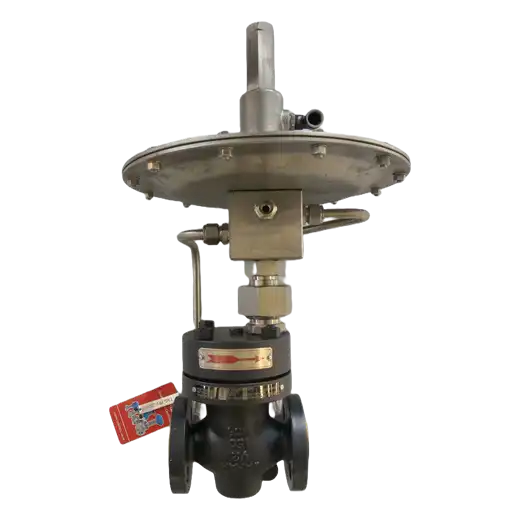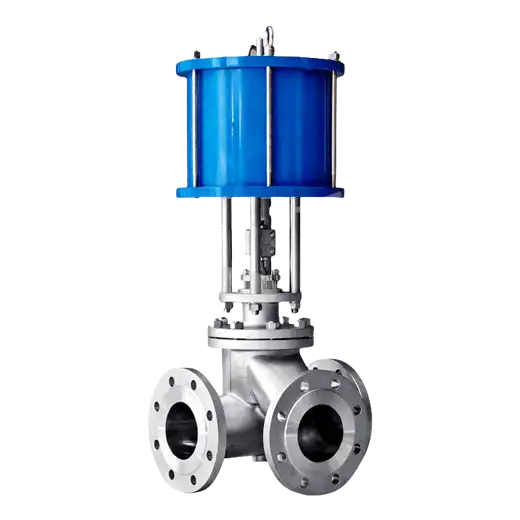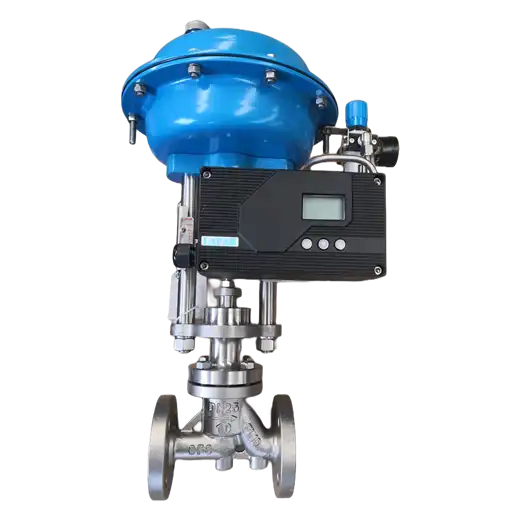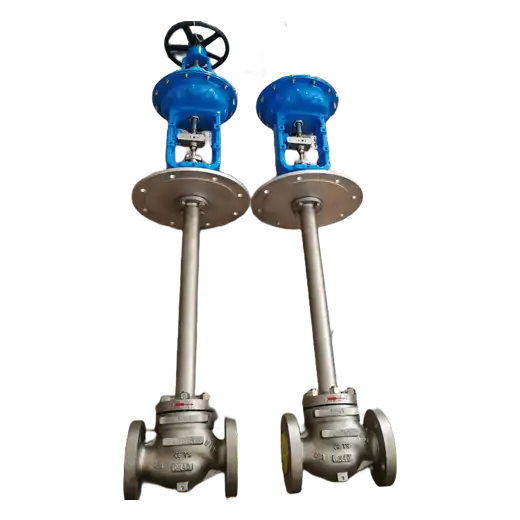
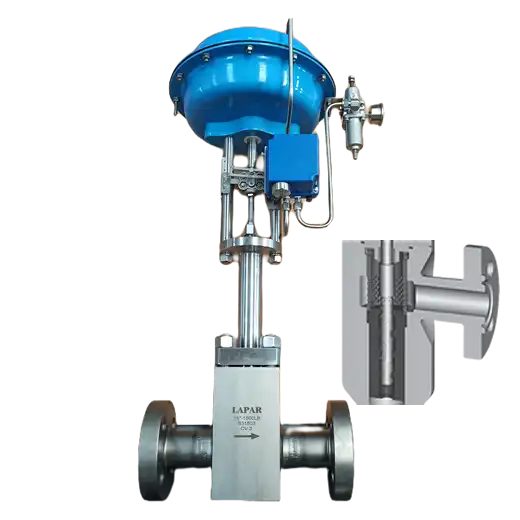
Multistep Cascade Trim Control Valve is a modulating valve whose trim lets pressure down through a series of staged restrictions, keeping every interstage pressure above the fluid's vapour pressure so that cavitation, flashing, noise and erosion are controlled at source rather than repaired downstream.
The Question Behind the Quotation
When a cascade trim valve is quoted against a standard cage-guided valve of the same size, the same pressure class and the same Cv, the difference in price is obvious and the difference in performance is not. That is a legitimate question and it deserves a straight answer rather than a catalogue page. The comparison that decides it is not the purchase order — it is what the two valves cost over a run length, and on severe letdown duty those figures diverge by an order of magnitude.
A single-restriction trim converts the entire pressure drop into kinetic energy at one point. Where that energy exceeds what the materials and the fluid can absorb, the consequences appear in a predictable order. In liquid service the pressure at the vena contracta falls below the vapour pressure, bubbles form, and their collapse against the plug and cage produces cavitation damage that removes material rather than merely wearing it. In gas and steam service the same energy becomes aerodynamic noise and high-velocity jet impingement. Either way, the trim erodes, leakage climbs past Class IV, control resolution degrades, and the valve comes out at the next opportunity — which on a continuous plant means an unplanned shutdown rather than a planned one. On duties severe enough to need staged trim, a single-restriction valve may last weeks. The replacement cost, the lost production and the downstream pipe wall thinning all belong in the same calculation as the valve price.
Cascade trim addresses this by geometry rather than by material hardness. The flow cascades through a series of staged restrictions — stacked disc plates, tortuous labyrinth paths or drilled cages arranged in sequence — so that each stage takes only part of the total differential. Interstage pressure is calculated to stay above the fluid's vapour pressure at every point, which removes the thermodynamic precondition for cavitation entirely. Simultaneously, the flow is divided into many small parallel paths, so the peak velocity in any single passage stays below the erosion limit of the trim material, and acoustic energy is distributed across numerous small sources rather than concentrated in one. This is why a correctly staged valve can meet a noise specification without a downstream silencer or acoustic lagging, which frequently costs more than the trim upgrade itself.
Stage count is the design variable, and it is derived rather than selected. Too few stages and the valve fails as described above. Too many is also a mistake: each additional stage adds small passages that can plug with solids, adds cost, adds pressure drop and reduces rangeability, so an over-staged valve on a clean, low-differential service is a worse purchase than a standard cage. The correct number comes from the actual pressure profile, temperature, medium and its vapour pressure, allowable noise and allowable outlet velocity. Our trim designs are modular, so stage modules can be added or removed at a turnaround to suit changed process conditions without replacing the body. We calculate the staging before we quote, supply the predicted noise figure with the valve, and we will recommend a standard cage, a multi-hole cage or a different valve family where your duty does not justify a cascade trim.
Key Features
How Cascade Trim Compares with Other Trim Families
| Trim Family | How It Handles the Pressure Drop | Best Suited To | Principal Limits |
|---|---|---|---|
| Standard window cage | Single restriction; the full differential is converted at one vena contracta. | General liquid and gas control at moderate differential pressure; clean media; wide rangeability. | Cavitates, flashes and erodes rapidly once the differential exceeds roughly the manufacturer's cavitation index limit. |
| Multi-hole cage | One stage, but the flow is split into many small jets to disperse acoustic energy. | Gas and steam letdown where aerodynamic noise is the governing constraint. | Does not prevent cavitation in liquid service, since the pressure still falls in a single step. |
| Drilled-hole multi-stage cage | Several drilled stages in series; pressure steps down progressively. | Cavitating and flashing liquid letdown at moderate to high differential. | Small drilled passages are vulnerable to plugging by solids and polymerising media. |
| Cascade / stacked-disc trim | Flow cascades through a calculated number of staged restrictions, with multi-path splitting at each stage. | Severe liquid and gas letdown where cavitation, flashing, noise and erosion must all be controlled at source. | Highest cost of the families listed; passage size limits solids handling; over-staging reduces rangeability. |
| Tortuous-path labyrinth trim | Energy dissipated through many direction changes in a long, narrow, tortuous passage. | The most severe liquid letdown duties, including very high differential and near-saturated conditions. | Narrowest passages of any family; strictest cleanliness requirements; longest lead time. |
What the Cascade Trim Design Delivers
- Interstage Pressure Calculated, Not Estimated — Stage pressures are derived from real-fluid behaviour for your actual medium, temperature and pressure profile, so that no point in the trim falls below the vapour pressure. This removes the thermodynamic precondition for cavitation rather than merely slowing its effects.
- Multi-Path Velocity Control at Every Stage — Each stage divides the flow into numerous small parallel paths, keeping peak passage velocity below the erosion limit of the selected trim material. This protects the trim and the body and limits the wall thinning that otherwise migrates into the downstream spool.
- Noise Reduction Achieved in the Trim — Acoustic energy is distributed across many small sources instead of concentrated in one high-velocity jet, so a predicted noise figure within your specification is frequently achievable without a downstream silencer, diffuser plate or acoustic lagging.
- Modular Stage Count, Field-Reconfigurable — Stage modules can be added, removed or replaced during a turnaround window to suit changed process conditions — catalyst ageing, feedstock variation, load reduction — without replacing the body, bonnet, actuator or piping.
- Erosion Confined to Replaceable Elements — Where damage does occur it is concentrated in the replaceable disc stack or cage elements rather than in the pressure-containing body, converting a whole-valve replacement into a consumable change.
- Characterised Flow Through the Trim Stack — Linear, equal percentage or custom inherent characteristics are built into the stage geometry, so the valve retains its specified characteristic across the full stroke rather than only at the first stage.
- Hard Trim Materials for the Severe End of the Range — 17-4PH, Inconel 625 / 718 / X-750, Hastelloy C276, solid Stellite 6, tungsten carbide and ceramic elements are available where the service combines high differential with abrasion, corrosion or high temperature.
- Verified Performance Supplied With the Valve — Predicted noise calculated to IEC 60534-8-3 (aerodynamic) and IEC 60534-8-4 (hydrodynamic); seat leakage tested to ANSI/FCI 70-2; shell and seat testing to API 598 and IEC 60534-1, with material traceability and PMI verification.
Typical Applications
- Boiler Blowdown and Continuous Blowdown Letdown — Saturated water let down from drum pressure to a flash tank or atmosphere. This is among the most severe duties in a power plant: the fluid flashes across the trim and a single-restriction valve is consumed rapidly. Cascade trim keeps the staging above the vapour pressure and confines the flashing energy to replaceable elements.
- High-Pressure Condensate and Heater Drain Letdown — Drain coolers, feedwater heaters and deaerator drains let down against substantial back pressure with continuous high-cycle operation. Staged trim prevents the cavitation that otherwise erodes the seat and produces the characteristic cracking noise operators report.
- Rich Amine and Glycol Letdown from Absorber to Regenerator — High differential across a corrosive, sometimes solids-laden solvent with dissolved acid gases. Staging limits the cavitation that accelerates erosion-corrosion, while duplex or 316 metallurgy addresses the chemistry.
- Hydrocracker and Hydrotreater Effluent and Separator Letdown — High-pressure separator letdown, hot separator level control and reactor effluent pressure reduction in hydrogen-rich service at elevated temperature. Staged trim combined with F22 / F91 bodies and NACE-compliant materials addresses hydrogen attack, sulfide stress cracking and erosion together.
- Steam Pressure Letdown with a Strict Noise Specification — Reduction from supercritical, ultra-supercritical or high-pressure steam mains to process headers where the site noise limit governs the design. Multi-path staging achieves the predicted level in the trim, avoiding the silencer and lagging that a single-restriction valve would require.
- Desuperheating Spray Water and Attemperator Control — Injection of atomising water into superheated steam at high differential. Staged trim prevents the flash-back and pulsation that cause thermal shock and cracking in downstream headers and turbine inlet components.
- LNG, Cryogenic and Industrial Gas Letdown — Pressure reduction of liquefied natural gas, nitrogen, oxygen, argon and ethylene at temperatures to -196 °C, where austenitic trim and extended bonnets are specified alongside the staged pressure profile.
- Reverse Osmosis Brine and Energy Recovery Letdown — High-pressure brine let down across energy recovery devices in desalination plants. Continuous duty at high differential with a corrosive, scale-forming medium makes trim life the governing economic factor.
- Petrochemical Reactor Feed and Product Letdown — Pressure reduction between reactor and fractionation stages, ethylene and propylene process letdown, and product transfer between pressure levels where stable modulation across wide turndown is required alongside cavitation control.
- Wellhead, Test Separator and Manifold Reduction — Production letdown where sand and scale may be entrained. Staged trim is specified with erosion-resistant materials and, where solids content makes small passages untenable, a different valve family is recommended instead.
These duties are ordered from the most severe downward, and the ordering matters: cascade trim earns its premium in proportion to how much energy the trim has to absorb. At the top of the list, where saturated water flashes across a large differential continuously, the difference between a staged trim and a standard cage is measured in weeks versus years. Lower down the list, where the differential is modest and the medium is clean, a standard or multi-hole cage may be entirely sufficient and the cascade trim would be an unnecessary purchase. The specification is therefore resolved from the energy released across the trim — upstream and downstream pressure, temperature, medium and its vapour pressure, flow range, allowable noise, allowable outlet velocity and any entrained solids — and worked backwards to stage count, passage geometry, trim metallurgy, body pattern and actuator sizing. We run those calculations before we quote, supply the predicted noise figure with the valve, and will tell you when a cheaper trim is the correct answer for your duty.
Technical Specifications
Size, Pressure and Temperature
Valve Size: DN 25 - DN 400 (NPS 1 - NPS 16); larger sizes on engineered request
Pressure Class: ASME Class 150 - Class 2500; DIN PN 16 - PN 400
Operating Temperature: -196 °C to +566 °C (-320 °F to +1050 °F), limited by body material, trim, balance seal and bonnet selection
Valve Style: Straight (globe) pattern, Angle pattern, Y-pattern
Cascade Trim Design
Trim Architecture: Staged restriction elements in series — stacked disc plates, drilled-hole multi-stage cage, tortuous-path labyrinth stack, multi-path flow splitter
Stage Count: 3 - 12+ stages, calculated from the pressure profile, medium vapour pressure, allowable noise and allowable outlet velocity
Interstage Pressure Basis: Calculated to remain above the fluid vapour pressure at every stage under all specified operating points, including transients and minimum flow
Modularity: Stage modules field-reconfigurable at turnaround without replacing body, bonnet, actuator or piping
Balance Arrangement: Pressure-balanced plug with balance port and seal ring, or unbalanced solid trim where solids would plug a balance port
Flow Control and Seating
Flow Characteristic: Linear, Equal Percentage, Quick Opening, Custom characterized profile built into the stage geometry
Seat Leakage: Class IV, Class V per ANSI/FCI 70-2; Class VI with soft seat at reduced temperature
Seat Type: Metal-to-metal lapped, Stellite hard-faced, Solid Stellite, Soft seat PCTFE / PEEK / graphite
Turndown Capability: to 50:1 with characterized trim and positioner; reduced as stage count increases — confirm per duty
Predicted Noise: Calculated to IEC 60534-8-3 (aerodynamic) and IEC 60534-8-4 (hydrodynamic); predicted figure supplied with the valve
Body and Trim Materials
Cast Body Materials: WCB, WC6, WC9, C5, C12A, LCC, CF8, CF8M, CF3M, A890 4A / 5A duplex and super-duplex, Alloy 20
Forged Body Materials: A182 F22 Cl.3, F91 / F911, F316 / F316H, F51, F55, A105, 4130
Trim and Stage Element Materials: 316 / 316L, 410, 17-4PH H900 / H1025, Alloy 6 (Stellite) hard-faced, solid Stellite 6, Hastelloy C276, Inconel 625 / 718 / X-750, Tungsten carbide, Ceramic
Stem Material: 17-4PH, Inconel X-750, 410, 316 — nitrided or hard-chromed
Balance Seal Material: Graphite, PTFE, FKM, Piston ring — selection sets the balanced trim temperature ceiling
Connections, Bonnet and Stem Sealing
End Connections: Flanged (ASME B16.5 / B16.47, DIN EN 1092-1), Ring Type Joint (RTJ) per ASME B16.20, Butt-weld, Socket-weld
Bonnet Type: Bolted with die-formed graphite or spiral-wound gasket, Pressure-seal, Extended (high temperature), Cryogenic, Finned, Bellows-sealed with safety packing backup
Stem Seal: Live-loaded die-formed graphite, PTFE V-ring, High-pressure packing set with lantern ring
Emission Control: Low-emission systems per ISO 15848-1 and TA-Luft
Face-to-Face: IEC 60534-3-2 / ISA 75.01, EN 558
Actuation and Instrumentation
Actuator Type: Pneumatic diaphragm, Pneumatic piston (single- and double-acting, spring return), Hydraulic, Electro-Hydraulic, Electric, Manual handwheel with gear reduction
Fail Action: Fail Open, Fail Close, Fail Last Position
Topworks Interface: ISO 5211 / standard yoke mounting
Accessories: Smart positioner (4-20 mA / HART / Foundation Fieldbus / Profibus), Electro-pneumatic positioner, Limit switch box, Solenoid valve, Air filter regulator, Volume booster, Air lock relay, Position transmitter, Manual override, Locking device, Hydraulic power unit
Standards, Testing and Certification
Design Standards: IEC 60534, ASME B16.34, EN 12516, ASME B16.5 / B16.20 / B16.47 for connections
Testing Standards: ANSI/FCI 70-2 seat leakage, API 598, IEC 60534-1, EN 12266-1, ISO 5208
Calculation Standards: IEC 60534-8-3 and 8-4 for noise, ISA S75.01 for capacity, ISA RP75.23 cavitation considerations
Certifications: CE / PED 2014/68/EU, ATEX, ISO 9001, NACE MR0175 / ISO 15156 for sour service, SIL-capable, TA-Luft, Fire-safe design on request
Service Conditions and Media
Media: Boiler blowdown and saturated condensate, High-pressure feedwater, Supercritical and superheated steam, Hydrogen-rich hydrocarbon streams, Rich amine and glycol, Natural gas and process gas, LNG and cryogenic fluids, RO brine, Produced water
Critical Service: Cavitation, Flashing, Very high differential pressure, Noise abatement, Erosive, Corrosive, Sour service, Hydrogen attack, High temperature, Cryogenic, Continuous high-cycle throttling
Industries: Power Generation, Oil and Gas, Refining, Petrochemical, Fertiliser and Ammonia, Chemical Processing, LNG and Industrial Gases, Desalination, Metals and Mining
Stage Count Basis: Stage count is not a catalogue selection. It is derived from the actual upstream and downstream pressure, temperature, medium and its vapour pressure, flow range, allowable noise and allowable outlet velocity. Under-staging leaves the valve to cavitate or erode; over-staging adds cost and pressure drop, narrows the passages that can plug, and reduces rangeability — so an over-staged valve on a clean, low-differential service is a worse purchase than a standard cage.
When a Standard Cage Is the Better Buy: Clean, solids-free media at modest differential pressure; noise levels already inside specification with a standard or multi-hole cage; services requiring maximum rangeability; and duties where the small passages of a cascade trim would plug. In these cases we will quote the simpler trim and say why.
Solids Handling: Small staged passages are vulnerable to plugging by solids, scale, polymerising media and heavy slurry. Where solids are present, specify a trim with passages sized for the particle distribution, an angle-pattern body with a flushing connection, or a different valve family.
Other Configurations: Consult our engineering team for sizes above DN 400, pressures above Class 2500, exotic alloys, tungsten carbide or ceramic stage elements, retrofit of cascade trim into existing valve bodies, oxygen-clean or cryogenic degreased construction, or complete actuated assemblies with hydraulic power units and control panels.
Frequently Asked Questions
What is a cascade trim control valve?
A cascade trim valve lets pressure down through a series of staged restrictions rather than a single one, so the flow cascades from stage to stage. Each stage takes only part of the total differential, and the interstage pressure is calculated to stay above the fluid's vapour pressure, which removes the precondition for cavitation. Note that "cascade trim" refers to the valve internals — it is unrelated to a cascade control loop, which is a control strategy in which one controller's output sets the setpoint of another.
How is cascade trim different from multi-stage anti-cavitation trim?
The terms overlap and manufacturers use them inconsistently, so always ask which construction is meant. Both stage the pressure drop to prevent cavitation. In common usage, cascade or stacked-disc trim achieves staging through a stack of plates or discs with aligned and offset passages that the flow works through in series, while multi-stage anti-cavitation trim more often refers to drilled-hole cages arranged in sequence. Tortuous-path labyrinth trim takes the same principle further with long, narrow, direction-changing passages for the most severe duties. Tell us the service conditions and we will recommend the construction that suits it rather than the one with the highest price.
How many stages does my application need?
It is calculated, not chosen. Send us upstream pressure, downstream pressure, temperature, medium (including its vapour pressure at operating temperature), required flow range, allowable noise level and allowable outlet velocity, together with any solids content. The stage count then follows from the pressure profile and the governing limit, which is normally noise, cavitation index or velocity rather than capacity. Typical designs run from three stages at moderate differential to twelve or more on the most severe letdown duties.
Can cascade trim handle dirty or solids-laden media?
Limited, and this is its main weakness. Staged trim works by dividing flow into many small passages, and small passages plug with solids, scale, polymerising media and heavy slurry. Once plugged, the pressure profile is destroyed, the valve loses its anti-cavitation behaviour and may not pass the required flow. Where solids are present we specify passages sized against the actual particle distribution, an angle-pattern body with a flushing connection, or a different valve family — a hard-seated ball or angle valve may serve better despite offering no staging.
Is a cascade trim valve always the right choice for letdown duty?
No, and it is worth being clear about when it is not. If the differential pressure is modest, the medium is clean and the noise level is already inside specification with a standard or multi-hole cage, a cascade trim valve is an unnecessary purchase that also narrows your rangeability and adds a plugging risk. The premium is justified where the energy released across the trim would otherwise destroy a single-restriction valve — flashing condensate, boiler blowdown, high-differential steam letdown, rich amine letdown and similar duties. We calculate before we quote and will recommend the simpler trim where your duty does not need this one.
Resources
Data Sheets:
Manuals: IOM
Product Photos: