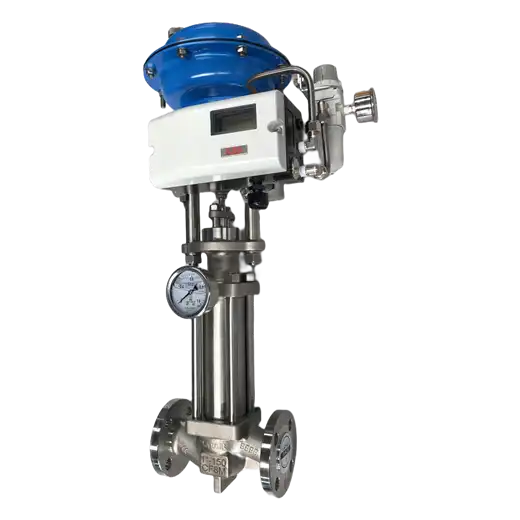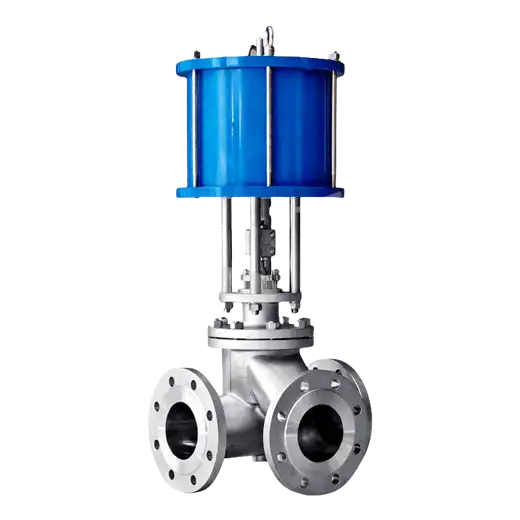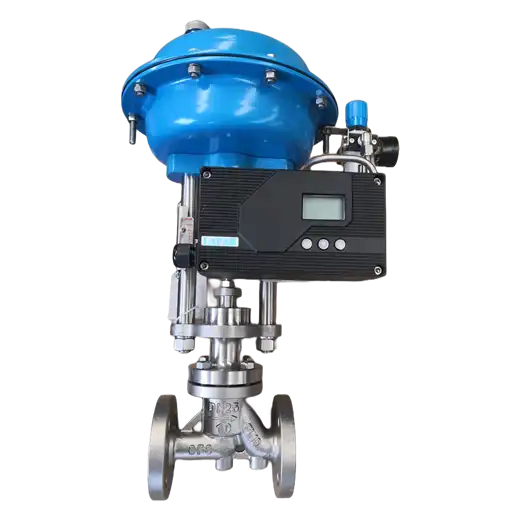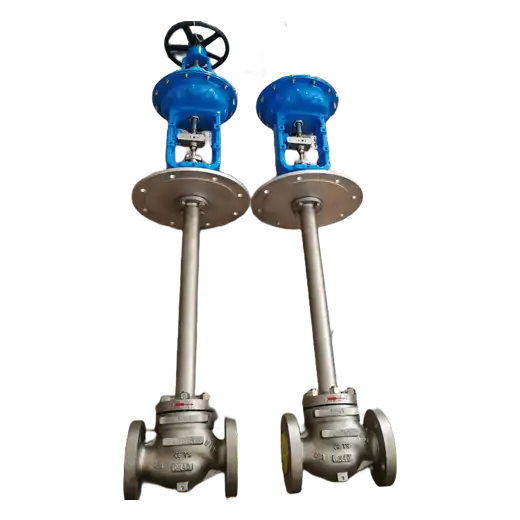
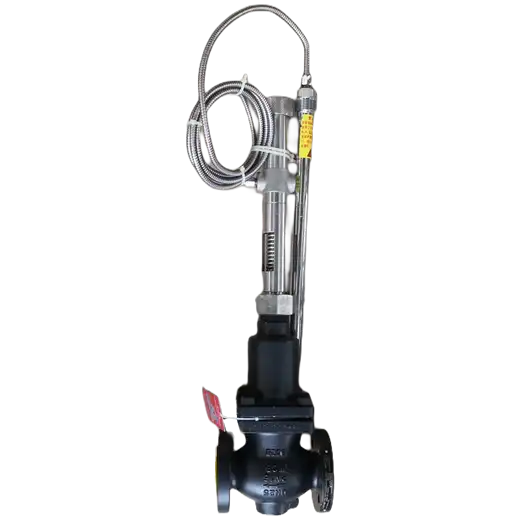
Self regulating temperature control valve modulates the flow of a heating or cooling medium in response to process temperature, using a thermal expansion sensing element and requiring no instrument air, electrical supply or controller.
Product Description
Temperature control is usually assumed to require a sensor, a transmitter, a controller and a control valve with a positioner. That assumption holds where accuracy and integration matter. It does not hold for a large number of simple heating and cooling duties — jacketed vessels, storage tank heating coils, heat exchanger bypass control, compressor and engine cooling water, and wash-water temperature control — where the requirement is simply to hold a temperature near a setpoint, reliably, without a control loop around it.
This valve does that in one component. A sensing bulb is installed in the process stream. The thermal expansion element inside it — liquid, vapour or wax filled depending on the range — expands or contracts with temperature, and that physical change is transmitted directly to the plug. Rising temperature moves the plug toward closing the heating medium or opening the cooling medium; falling temperature does the reverse. No signal conversion happens anywhere in the chain, and no external energy is consumed. Setpoint is adjusted mechanically at the regulator.
Two details determine whether this valve performs well, and both are installation matters rather than product matters. The sensing bulb must be positioned where it actually sees the controlled temperature — typically in the process outlet or in the vessel, not on a dead leg where it senses something slower or cooler than the fluid being controlled. And the bulb must be fully immersed; partial immersion produces a reading between fluid and ambient temperature, which is a common cause of a regulator that appears miscalibrated. The performance envelope should be stated honestly: accuracy and speed are lower than a tuned instrumented loop, and setpoint cannot be changed remotely. Where either matters, a control valve with a temperature transmitter and controller is the correct answer.
Key Features
- No external power or control loop: the thermal element converts temperature directly into plug motion, with no air, wiring, transmitter or controller.
- Heating or cooling action: configured to open or close on rising temperature to suit the medium being controlled.
- Mechanical setpoint adjustment: setpoint is set at the regulator without configuration tools or control system integration.
- Sensing element selected by range: liquid, vapour or wax fill chosen to match the required temperature band and response.
- Suitable for remote and unattended locations: no electrical components, so no hazardous area burden and no power infrastructure required.
- Fails to a defined position: spring arrangement determines fail action, specified to suit the process rather than discovered after installation.
Typical Applications
- Jacketed vessel and reactor temperature control — modulating heating or cooling medium to the jacket to hold batch temperature.
- Storage tank heating coils — maintaining product temperature without a control loop at the tank.
- Heat exchanger temperature control — regulating the heating or cooling medium flow on the utility side.
- Engine, compressor and pump cooling water — holding cooling water temperature within a band at the point of use.
- Wash water and rinse water temperature control — simple, dependable temperature regulation on utility services.
Most complaints about self-operated temperature regulators turn out to be installation problems. A bulb on a dead leg, a bulb only partly immersed, or a bulb located where the fluid is not representative will each produce a regulator that looks miscalibrated but is behaving exactly as it should. We confirm the sensing range and fill type against your temperature band, and specify the bulb location and immersion requirement as part of the selection rather than leaving it to the installer. Where your duty needs tighter accuracy or remote setpoint, we will tell you to use a transmitter and a control valve instead.
Technical Specifications
| Valve Size | NPS 1/2 – NPS 6 / DN 15 – DN 150 |
|---|---|
| Pressure Class | ASME Class 150 to 300; DIN PN16, PN25, PN40 |
| Operating Temperature | [TBC — confirm sensing ranges against LAPAR datasheet] |
| Control Function | Temperature control on heating or cooling medium; opens or closes on rising temperature |
| Sensing Element | Thermal expansion bulb — liquid, vapour or wax fill, selected by range |
| Power Requirement | None — self-energized by thermal expansion |
| Process Connection | Flanged, NPT Threaded, Socket Weld, Custom |
| Body Style | Straight (Globe), Angle, Three Way |
| Actuating Element | Diaphragm, Piston or Bellows |
| Sensing Bulb Installation | Full immersion required; bulb located in representative process flow |
| Seat Leakage | Class IV per ANSI/FCI 70-2 (soft seat options on request) |
| Critical Service | Temperature Regulation, Heating Medium, Cooling Medium, Remote Location, No Air Supply |
| Body Materials | Carbon Steel, Stainless Steel, Bronze on request |
| Certifications | ASME, PED, ATEX (no electrical components) |
| Media | Steam, Water, Thermal Oil, Glycol, Process Liquids |
| Industries | Chemical & Petrochemical, Food & Beverage, Pharmaceutical, Power, Oil & Gas, HVAC & District Energy |
Frequently Asked Questions
How does the valve sense temperature without a transmitter?
A sensing bulb containing a thermal expansion element is immersed in the process stream. As temperature changes, the element expands or contracts, and that physical movement is transmitted directly to the plug. No signal conversion and no external energy are involved.
Can it be used for both heating and cooling?
Yes. The valve is configured to open or close on rising temperature, so it can throttle a heating medium or a cooling medium depending on the duty. The action must be specified at order.
Why does my regulator seem miscalibrated?
In most cases the sensing bulb, not the regulator, is the cause. A bulb on a dead leg, a bulb only partly immersed, or a bulb in an unrepresentative location will all produce a reading that does not match the controlled fluid. Full immersion in representative flow is required.
How accurate is it compared to an instrumented loop?
Less accurate and slower, by design. Where tight temperature control or remote setpoint adjustment is required, a temperature transmitter with a controller and an actuated control valve is the correct choice.
Does it need any utilities?
None. No instrument air, no electrical supply and no control system. That is the principal reason to specify it on remote tanks, skids and utility heating duties.
Resources
Data Sheets:
Manuals: IOM
Product Photos: