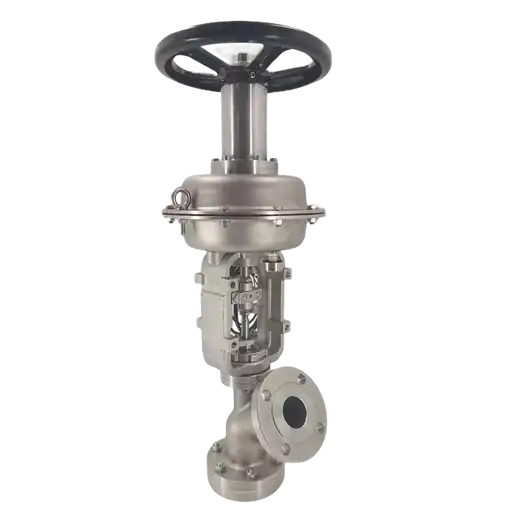
Flush Bottom Discharge Control Valve — a vessel-bottom-mounted modulating valve whose plug closes perfectly flush with the tank's internal surface, eliminating dead legs and enabling precise, contamination-free discharge of slurries, viscous fluids, crystallizing liquors and corrosive process media.
Product Description
Conventional discharge arrangements leave an unavoidable pocket of stagnant fluid between the vessel bottom outlet and the seat of a standard control valve installed below it. That dead leg is where batches cross-contaminate, where crystals grow and bridge, where polymers cure, where solids settle and compact, and where cleaning solvents cannot reach. The Flush Bottom Discharge Control Valve removes the problem at its source: its body is bolted directly to the vessel bottom nozzle, and the closing element travels in the same plane as the tank's internal surface. When the valve is shut, the plug and the vessel floor form one continuous, flush boundary — there is no cavity to hold product, no pocket to foul, and nothing left behind at the end of a discharge cycle.
As a control valve rather than a simple block valve, it is engineered for continuous modulating service. A characterized plug profile — linear, equal percentage or a geometry tailored to the actual installed gain of the system — is driven by a pneumatic, electric or hydraulic actuator and positioned by a smart positioner, so operators command discharge rate, vessel level, filtration pressure drop or transfer time with the same accuracy they expect from any line-mounted regulator. Pressure-balanced and cage-guided trim options extend the design into larger sizes and higher pressure differentials, where an unbalanced plug would demand an oversized actuator and deliver poor stability. Soft-seated versions (PTFE, RPTFE, PCTFE, PEEK) achieve bubble-tight Class VI shutoff for hazardous or high-value media; metal-to-metal seats with hard-facing alloys handle abrasive slurries and elevated temperature service.
Two plug configurations cover the practical realities of different process media. The ram type opens by driving the plug upward into the vessel, which actively displaces accumulated solids and is preferred where product tends to build up around the outlet or where the tank must be emptied completely. The disc type opens by retracting the plug downward into the valve body, giving a full-bore, unrestricted flow path that suits free-flowing liquids, limited headroom installations and duty cycles with frequent partial-stroke operation. Steam-jacketed or hot-oil-jacketed bodies keep high-viscosity and crystallizing media above their pour point or saturation temperature throughout the valve cavity, preventing the plug from freezing in place between cycles.
Every unit is specified against the actual process rather than selected from a generic catalogue line. Body and trim metallurgy, seat material, plug characteristic, actuator size, fail-safe direction, jacketing, surface finish and connection dimensions are all resolved from the vessel nozzle standard, the medium's abrasiveness and corrosivity, the operating pressure differential, the required turndown and the applicable industry hygiene or safety codes. The result is a bottom-outlet valve that behaves as an integral part of the reactor — not as an accessory bolted underneath it.
Key Features
- True Zero-Dead-Leg Flush Closure: The seat plane is co-planar with the vessel's internal bottom surface, removing the stagnant pocket that causes cross-batch contamination, crystal bridging, polymer fouling and incomplete drainage. This is decisive in multi-product campaign plants and in pharmaceutical or fine-chemical service where validated cleanability and batch-to-batch purity are contractual requirements, not preferences.
- Two-Probe / Ram and Disc Plug Configurations: Ram-type plugs stroke upward into the tank to displace settled solids and guarantee complete emptying; disc-type plugs stroke downward into the body for full-bore, unobstructed flow. The correct configuration is selected from the solids content, particle size, settling tendency and required drain completeness of the specific medium.
- Modulating Trim Designed for Control, Not Just Isolation: Characterized plug profiles, cage guiding and pressure-balanced constructions deliver stable, repeatable throttling across wide turndown with low actuator stiffness requirements — suitable for level control, discharge-rate control and pressure-letdown duty, not merely on/off draining.
- Sealing Options Matched to the Medium: Soft seats in PTFE, RPTFE, PCTFE or PEEK provide Class VI bubble-tight shutoff at moderate temperatures; Stellite-hard-faced or fully metal-seated designs resist erosion from abrasive slurries and remain functional up to +450 °C. Live-loaded, low-emission stem packing systems meet ISO 15848-1 and TA-Luft requirements for fugitive-emission-sensitive service.
- Full Metallurgy Range for Corrosive Duty: Standard CF8M, CF3M and WCB castings, plus duplex and super-duplex (A890 4A / 5A), Alloy 20, Hastelloy B2 / C276, Monel 400, Inconel 625, titanium and tantalum — with glass-lined and PFA-lined constructions available for the most aggressive mineral-acid and halide environments.
- Jacketed Bodies for Viscous and Crystallizing Service: Integral steam, hot-oil or electric-trace jackets maintain the medium above its crystallization or pour point inside the valve cavity, preventing plug seizure, seat plugging and product degradation during standby periods.
- Wide Actuation and Instrumentation Compatibility: Pneumatic diaphragm and piston actuators with spring-return fail-open / fail-close action, electric actuators, hydraulic actuators, manual handwheel and gear overrides; mounted with smart positioners (4–20 mA / HART / Foundation Fieldbus), limit switches, solenoid valves, volume boosters, air-lock relays and air filter regulators.
- Built to Recognised International Codes: Designed and tested in accordance with ASME B16.34, API 6D and EN 12516; flanges to ASME B16.5 / B16.47, DIN EN 1092-1 or the customer's vessel nozzle standard; pressure testing to API 598, EN 12266-1 or ISO 5208; actuator mounting interface to ISO 5211.
Typical Applications
- Pharmaceutical and Fine-Chemical Reactors: Bottom discharge of API crystallization slurries, filtered cakes washed in place, and multi-product campaign batches where residual holdover must be eliminated and cleaning validated. Ram-type plugs with electropolished 316L bodies and sanitary surface finishes (Ra ≤ 0.8 µm) support GMP cleanability and prevent cross-contamination between campaigns.
- Crystallizers, Evaporators and Precipitators: Continuous or batch draw-off of saturated mother liquor carrying a high solids burden, where temperature loss in an unjacketed valve causes crystals to grow onto the plug and seat and lock the valve shut. Jacketed flush bottom valves keep the discharge path above saturation temperature and keep solids moving.
- Polymer, Resin and Adhesive Production: Handling of high-viscosity, thermally sensitive, self-curing or sticky media — resins, latex, hot melt, silicone, epoxy — where a dead leg would polymerize into a solid plug. Jacketed bodies and non-stick seat treatments maintain operability over long production runs.
- Pressure and Vacuum Filtration (Nutsche Filters, Filter Dryers): Discharge of filter cake and liquor from agitated Nutsche filter dryers under pressure or vacuum, with the flush closure preserving vessel integrity and preventing product loss into a valve pocket. Metal-seated versions tolerate the abrasion from wet cake and residual solids.
- Hydrometallurgy, Mining and Mineral Processing: Letdown and transfer of abrasive, corrosive leach slurries, tailings, thickener underflow and pregnant leach solution containing acid, chloride and entrained particulates. Duplex bodies with hard-faced trim resist the combined erosive-corrosive attack that rapidly destroys standard valves.
- Petrochemical and Refining Services: Catalyst slurry draw-off, spent-caustic and amine bottoms, sulfur and asphalt discharge, and reactor effluent separation vessels where high temperature, high differential pressure and solids-laden media demand robust, dead-leg-free bottom outlets.
- Food, Beverage and Dairy Processing: Sanitary discharge of syrups, chocolate and cocoa mass, edible oils, dairy concentrates, fruit pulps and starch slurries, in electropolished hygienic constructions compatible with CIP/SIP cleaning regimes and food-contact material requirements.
- Water, Wastewater and Sludge Treatment: Draw-off of settled sludge, lime slurry, digestate and dewatered solids from clarifiers, thickeners and digestion tanks, where settling and compaction in a conventional valve body would otherwise block the outlet.
Across every one of these services the governing requirement is the same: whatever the vessel holds must leave the vessel completely, cleanly and under precise control, with no residue trapped between the tank floor and the valve seat. That is why flush bottom discharge valves are specified wherever product is expensive, batches are run in campaign, media crystallize or polymerize on cooling, solids settle and compact, or hygiene validation must be demonstrated to an auditor. Selecting the right unit, however, is not a matter of catalogue matching — plug configuration, body and trim metallurgy, seat class, jacketing, surface finish and actuator sizing all have to be resolved against the actual process fluid, the vessel nozzle, the operating differential and the applicable industry code. Our engineering team works from your process data sheet to deliver a bottom-outlet valve that performs as an integral part of the reactor rather than as a weak point beneath it, turning a chronic source of contamination, blockage and lost yield into a reliable, controllable and long-life discharge point.
Specifications
Sizing, Pressure and Temperature
Valve Size: NPS 1 - NPS 12 (DN 25 - DN 300); larger sizes to NPS 20 / DN 500 on request
Pressure Class: ASME Class 150 - Class 600; DIN PN 10 - PN 100
Operating Temperature: -196 °C to +450 °C (-320 °F to +842 °F), dependent on seat and trim selection
Valve Type: Flush bottom / tank bottom discharge control valve, straight-pattern and angle-pattern
Plug, Trim and Flow Control
Plug Configuration: Ram type (plug opens upward into vessel); Disc type (plug opens downward into body)
Trim Style: Unbalanced plug, Pressure-balanced plug, Cage-guided, Contoured plug, V-port
Flow Characteristic: Linear, Equal Percentage, Quick Opening, Custom characterized profile
Seat Leakage: Class IV, Class V, Class VI per ANSI/FCI 70-2; bubble-tight with soft seat; API 598 shell and seat testing
Materials and Surface Finish
Body Materials: WCB, LCB, CF8, CF8M, CF3, CF3M, A890 4A / 5A duplex and super-duplex, Alloy 20, Hastelloy B2 / C276, Monel 400, Inconel 625, Titanium, Tantalum; glass-lined and PFA-lined constructions
Trim Materials: 316 / 316L, 410, 17-4PH, Duplex, Hastelloy C276, Alloy 6 (Stellite) hard-faced, solid Stellite, PTFE / RPTFE / PCTFE / PEEK seated
Surface Finish: Industrial finish; sanitary electropolished Ra ≤ 0.8 µm or Ra ≤ 0.4 µm for hygienic and pharmaceutical duty
Connections, Bonnet and Jacketing
Process Connections: Flanged (ASME B16.5 / B16.47, DIN EN 1092-1), Butt-weld, Socket-weld, NPT threaded, Custom vessel-nozzle match
Bonnet / Stem Seal: Standard, Extended, Bellows-sealed, Live-loaded adjustable packing; low-emission per ISO 15848-1 and TA-Luft
Jacketing: Steam jacket, Hot-oil jacket, Electric trace heating, Insulated (cold service)
Actuation and Instrumentation
Actuator Type: Pneumatic (diaphragm / piston, single- and double-acting, spring return), Electric, Hydraulic, Electro-Hydraulic, Manual handwheel, Gear operator
Fail Action: Fail Open, Fail Close, Fail Last Position
Accessories: Smart positioner (4-20 mA / HART / Foundation Fieldbus), Electro-pneumatic positioner, Limit switch box, Solenoid valve, Air filter regulator, Volume booster, Air lock relay, Position transmitter, Manual override, Locking device
Standards and Certifications
Design Standards: ASME B16.34, API 6D, EN 12516, ISO 5211 mounting interface
Testing Standards: API 598, EN 12266-1, ISO 5208
Certifications: CE / PED 2014/68/EU, ATEX, ISO 9001, API, NACE MR0175 / ISO 15156, SIL-capable, FDA / EU 1935/2004 compliant materials for food and pharma service
Service Conditions
Media: Slurries, Suspensions, Viscous liquids, Crystallizing liquors, Corrosive acids and alkalis, Abrasive particulates, Polymers and resins, Food and beverage products, Gases, Water, Steam
Critical Service: Zero dead leg, Solids-laden, Abrasive, Corrosive, Crystallizing, High viscosity, Polymerizing, Hygienic / Sterile, Vacuum, High temperature, Cryogenic, Multi-product campaign
Industries: Pharmaceutical, Fine and Specialty Chemicals, Petrochemical and Refining, Polymer and Resin, Food and Beverage, Hydrometallurgy and Mining, Pulp and Paper, Water and Wastewater, Industrial Gases, Power
Other Configurations: Consult our engineering team for special nozzle dimensions, non-standard materials, high-pressure differentials, extended temperature ranges, or complete skid-mounted discharge assemblies.
Frequently Asked Questions
What is a flush bottom valve used for?
It is installed directly on the bottom outlet of a reactor, crystallizer, filter or storage vessel and discharges contents with no dead leg between the vessel floor and the valve seat, preventing contamination, solids build-up and product loss.
What is the difference between ram type and disc type flush bottom valves?
A ram-type plug opens upward into the vessel, displacing settled solids and ensuring complete emptying; a disc-type plug opens downward into the valve body, giving a full-bore flow path suited to free-flowing liquids and limited headroom.
Can a flush bottom valve be used for throttling control?
Yes. When fitted with a characterized plug, positioner and suitable actuator, it modulates discharge rate, vessel level and filtration pressure with the same accuracy as a line-mounted control valve.
What materials are available for corrosive or abrasive media?
CF3M, duplex and super-duplex, Alloy 20, Hastelloy, Monel, Inconel, titanium and tantalum, plus glass-lined and PFA-lined constructions, with Stellite hard-facing or solid Stellite trim for abrasion.
Are jacketed versions available?
Yes. Steam, hot-oil and electric-trace jackets keep viscous, crystallizing or thermally sensitive media above their pour or saturation point inside the valve cavity.
Resources
Data Sheets:
Manuals: IOM
Product Photos: