
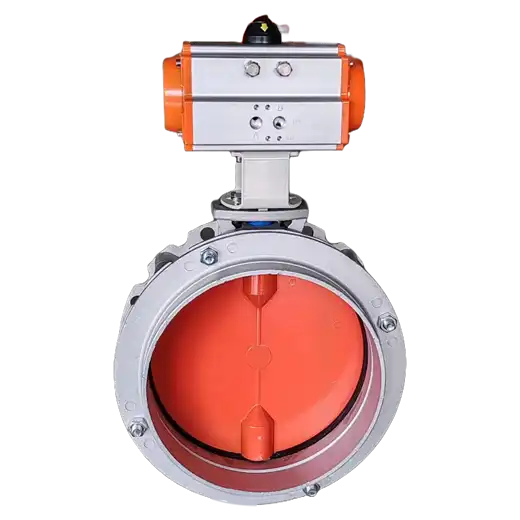
Aluminum Body Powder Butterfly Valve — a lightweight isolation valve purpose-built for dry bulk powder and pneumatic conveying duty, combining a thin-profile disc, an abrasion-resistant replaceable seat and full-bore flow in DN 50 to DN 300 for cement, food, plastics and fly ash service.
Product Description
A butterfly valve that performs well on water will often fail within weeks on dry powder, and the failure rarely looks like a valve problem. Powder does not flow like a liquid: it fluidises, it packs, it bridges, it abrades, and it generates static. A standard disc profile leaves a ledge where fines accumulate and compact until the disc can no longer seat; a standard rubber seat wears through at the leading edge from particle impingement; and a valve body designed for hydraulic pressure offers no answer to any of it. Specifying from a general-purpose catalogue is therefore how plants end up replacing the same valve position three times a year.
The Aluminum Body Powder Butterfly Valve is built around those specific failure modes rather than around a pressure class. Its disc is thin and sharply profiled so that powder slides clear instead of packing against it, the seat is an elastomer element selected for abrasion resistance and supplied as a replaceable part, and the flow path is full bore to keep pressure drop low in a conveying line where every kilopascal of blower energy is accounted for. The aluminium alloy body brings a further advantage that matters most on elevated and skid-mounted lines: at roughly half the mass of a comparable ductile iron body, it reduces support loading, eases installation at height and simplifies maintenance handling.
Configuration is driven by the medium, not by a default. Disc materials range from stainless 304 and 316 for corrosion-sensitive or food-contact powders, through aluminium bronze and coated carbon steel for abrasive mineral service, to polymer-coated discs where product adhesion is the dominant problem. Seat materials span silicone and EPDM for food, pharmaceutical and potable-contact duty, NBR for general industrial powders, polyurethane for highly abrasive cement, fly ash and mineral streams, and PTFE for chemically aggressive or non-stick requirements. Body styles are offered in wafer, lugged, flanged and clamp patterns so the valve drops into existing silo outlets, filter hoppers, conveying spools and truck-loading manifolds without adapter work.
One boundary should be stated plainly rather than discovered in service: an aluminium body is a strength and temperature-limited construction. It is the right choice for the low-pressure, moderate-temperature conditions that characterise most dry bulk handling and dilute-phase pneumatic conveying, and it is the wrong choice for high-pressure letdown, saturated steam, hot abrasive slurries or severe fire-exposure duty, where ductile iron, carbon steel or stainless bodies should be specified instead. Our engineering team will confirm the correct body material against your line pressure, operating temperature, medium abrasiveness and any applicable hygiene or ATEX requirement before the valve is built — and will say so when aluminium is not the answer.
Key Features
- Lightweight Aluminum Alloy Body
- Cast in A356 / ADC12 grade aluminium alloy, the body weighs roughly half of an equivalent ductile iron valve. The saving compounds on long conveying lines and elevated installations: lighter pipe supports, faster fitting at height, and single-person handling during maintenance.
- Thin-Profile Disc Engineered Against Packing and Bridging
- A reduced-thickness, sharply contoured disc presents no flat ledge for fines to accumulate on. Powder slides clear on closure instead of compacting into a bridge that blocks the disc from seating — the most common cause of premature leakage in powder service.
- Replaceable Abrasion-Resistant Seat
- The seat is a separate elastomer element, not a bonded or integral component. When particle impingement eventually wears it, it is replaced in minutes without removing the valve from the line or scrapping the body — converting a whole-valve replacement into a consumable change.
- Food and Pharmaceutical Grade Seat Options
- Silicone and EPDM seats comply with FDA 21 CFR 177.2600 and EU 1935/2004 for food-contact service. Combined with an electropolished stainless disc and Ra ≤ 0.8 µm surface finish, the valve supports flour, sugar, milk powder, starch and nutraceutical duty.
- Full-Bore, Low-Pressure-Drop Flow Path
- The open disc sits clear of the flow with minimal obstruction, keeping pressure drop low across the valve. In dilute-phase conveying, where the blower works against the total system resistance, a low-loss valve directly reduces energy consumption and protects conveying velocity.
- Bidirectional Bubble-Tight Shutoff
- Seat contact is maintained in both flow directions, so the valve isolates reliably regardless of which side carries pressure. This matters under silos and hoppers, where head pressure reverses as the vessel fills and empties.
- Natural Corrosion Resistance of the Aluminium Body
- The aluminium oxide film that forms spontaneously on the body surface resists atmospheric corrosion and many dry chemical powders, without the coating maintenance that carbon steel bodies require in humid or washdown areas.
- Standard ISO 5211 Actuation Interface
- The top flange follows ISO 5211, so pneumatic quarter-turn actuators, electric actuators, gear operators and manual levers mount directly with no adapter kit. Fail-open and fail-close spring-return configurations are available for emergency isolation.
Typical Applications
Dilute and Dense Phase Pneumatic Conveying Lines
Isolation of transfer lines, blow vessels, sender tanks and diverter points where the valve sits permanently in a pressurised air-and-powder stream. Full-bore design preserves conveying velocity and limits the pressure drop the blower must overcome, while the thin disc resists the packing that causes leakage at line pressure.
Cement, Fly Ash and Building Materials Handling
Silo discharge, batcher weighing hoppers, mixer inlet and outlet, and tanker loading for cement, fly ash, ground granulated slag, gypsum and dry mortar. These are among the most abrasive powders handled industrially; a polyurethane seat extends service life far beyond standard NBR in this duty.
Flour, Grain, Sugar and Food Powder Processing
Mill and bakery conveying, ingredient dosing, silo and big-bag discharge, and packaging line isolation for flour, starch, sugar, milk powder, cocoa, salt and spice blends. Food-grade silicone or EPDM seats, electropolished stainless discs and crevice-free construction meet hygiene requirements and withstand washdown.
Plastics Pellets, Granules and Polymer Powders
Injection moulding, extrusion, compounding and pelletising plants, where resin pellets, regrind and powder are transferred between silos, dryers, blenders and machine hoppers. Smooth disc surfaces and non-stick seat options prevent adhesion of fines and reduce the strand formation that causes hang-ups.
Pharmaceutical and Fine Chemical Powders
API, excipient and intermediate powder transfer in contained processing lines, including vacuum conveying, tablet press feeding and containment discharge. Electropolished contact parts, validated cleanability and ATEX-compatible actuation support both hygiene and dust-explosion protection requirements.
Dust Collection and Filter Hopper Discharge
Isolation beneath baghouse and cartridge filter hoppers, rotary valve inlets and dust collection spools. The valve must seal against dust migration and reverse air pulses while resisting the abrasion of collected particulate — duty that rapidly destroys general-purpose valves.
Mineral, Pigment and Metal Powder Handling
Titanium dioxide, calcium carbonate, silica fume, talc, barite, pigments and metal powders in both dry processing and additive manufacturing feed systems. Hard-faced or coated discs and polyurethane seats handle the combined abrasion and, where relevant, the reactivity of fine metal powders.
Silo, Big Bag and Tanker Loading and Unloading
Truck and rail tanker loading arms, big bag filling and discharge stations, and silo outlet isolation. Lightweight aluminium bodies reduce the load on loading structures and make manual operation of large-diameter valves practicable without a gearbox.
Across all of these services the medium itself dictates the specification, and no two powder streams behave alike. Abrasiveness determines whether a standard elastomer seat survives a month or a year; particle size and cohesion determine whether the disc will pack and bridge; food or pharmaceutical contact determines which seat materials are permissible at all; and line pressure determines whether an aluminium body is structurally adequate or must give way to iron or steel. There is no default configuration that satisfies these simultaneously. We specify from your process data — medium, particle size, bulk density, line pressure, operating temperature, cycle frequency and any hygiene or ATEX obligation — and we will recommend a different body material where aluminium is not the correct answer for your duty.
Technical Specifications
Size, Pressure and Temperature
Valve Size: DN 50 - DN 300 (NPS 2 - NPS 12)
Pressure Rating: PN 2.5 - PN 10; ASME Class 150 (lower limits apply to the aluminium body — confirm per duty)
Operating Temperature: -20 °C to +120 °C (-4 °F to +248 °F) standard; to +180 °C (+356 °F) with high-temperature seat
Differential Pressure: up to 10 bar with actuated operation; lower for manual lever operation
Body, Disc and Seat Materials
Body Material: Aluminium alloy A356, ADC12, 6061; anodised or coated finish available
Disc Material: Stainless 304 / 316, Aluminium bronze, Coated carbon steel, Polymer-coated disc, Electropolished stainless for food duty
Seat Material: Silicone (food grade), EPDM, NBR, Polyurethane (abrasion resistant), PTFE, FKM
Stem Material: Stainless 416 / 304 / 316, Duplex on request
Surface Finish: Industrial; sanitary electropolished Ra ≤ 0.8 µm or Ra ≤ 0.4 µm for food and pharmaceutical duty
Valve Design and Configuration
Valve Type: Concentric (resilient seated) butterfly valve for dry bulk powder service
Body Style: Wafer, Lugged, Flanged, Clamp (tri-clamp for sanitary duty)
Disc Profile: Thin-profile powder disc, anti-packing contoured edge
Seat Construction: Replaceable cartridge seat, field-renewable without line removal
Shutoff Class: Bidirectional bubble-tight; API 598 seat and shell testing
Operation: Quarter-turn 90°
Connections and Mounting
End Connections: Flanged (ASME B16.5, DIN EN 1092-1), Wafer between companion flanges, Lugged with threaded inserts, Sanitary clamp per ISO 2852 / DIN 32676
Top Flange: ISO 5211 actuator mounting interface
Stem Seal: O-ring, Adjustable gland packing, PTFE-lined stem bearing for abrasive dust exclusion
Face-to-Face: ISO 5752 / EN 558 short pattern
Actuation and Instrumentation
Actuator Type: Pneumatic (rack and pinion, single- and double-acting, spring return), Electric, Manual lever, Gear operator
Fail Action: Fail Open, Fail Close, Fail Last Position
Accessories: Solenoid valve, Limit switch box, Positioner, Air filter regulator, Speed controller, Manual override, Locking device, Position indicator
Hazardous Area: ATEX / IECEx compatible actuation and accessories for dust explosion protection zones
Standards and Certifications
Design Standards: EN 593, API 609, ISO 5752, ISO 5211
Testing Standards: API 598, EN 12266-1, ISO 5208
Certifications: CE / PED 2014/68/EU, ATEX, ISO 9001, FDA 21 CFR 177.2600 and EU 1935/2004 compliant seat materials for food contact
Hygiene Design: Crevice-free contact surfaces, CIP-compatible construction on sanitary versions
Service Conditions and Media
Media: Dry bulk powders, Granules and pellets, Cement and fly ash, Flour and food powders, Plastic resin, Mineral and metal powders, Dust collection product, Conveying air with entrained solids
Critical Service: Abrasive powder, Dust explosion zone, Food and pharmaceutical contact, Pneumatic conveying, Vacuum conveying, Silo discharge, Frequent cycling, Washdown area
Industries: Cement and Building Materials, Food and Beverage, Plastics and Polymer, Pharmaceutical, Chemicals and Pigments, Mining and Minerals, Power (fly ash), Agriculture and Grain, Waste and Recycling
Not Recommended For: High-pressure letdown, saturated or superheated steam, hot abrasive slurries, severe fire-exposure duty, or services above the aluminium body temperature limit — specify ductile iron, carbon steel or stainless bodies instead.
Other Configurations: Consult our engineering team for non-standard sizes, special alloys, extended temperature seats, explosion-protective designs, or complete actuated valve assemblies.
Frequently Asked Questions
Why use a purpose-built powder butterfly valve instead of a general-purpose one?
Dry powder packs, bridges and abrades in ways that liquids do not. A general-purpose disc leaves a ledge where fines compact and block the disc from seating, and a standard seat wears through at the leading edge from particle impingement. Powder-specific valves use a thin contoured disc that sheds material and a replaceable abrasion-resistant seat, which is why they typically last several times longer in the same position.
What are the advantages and limits of an aluminium body?
The advantages are weight (roughly half of ductile iron), natural corrosion resistance from the oxide film, and lower cost. The limits are structural: aluminium loses strength with temperature and has a lower allowable pressure than iron or steel. It suits low-pressure, moderate-temperature dry bulk and pneumatic conveying duty well, and should not be specified for high-pressure letdown, steam, hot slurries or fire-exposure service.
Which seat material should I choose for my powder?
Silicone or EPDM for food, pharmaceutical and potable-contact powders; NBR for general industrial duty; polyurethane for highly abrasive streams such as cement, fly ash and mineral powders; PTFE for chemically aggressive media or where product adhesion must be minimised. Tell us the medium, particle size and operating temperature and we will recommend the seat.
Can this valve be used in dust explosion protection zones?
Yes. ATEX and IECEx compatible pneumatic and electric actuators, limit switch boxes and solenoid valves are available for zones where combustible dust is present. Correct zone classification, earthing and bonding of the valve body remain the responsibility of the plant designer and must be confirmed against your site assessment.
Do you supply food-grade and sanitary versions?
Yes. Sanitary versions use clamp connections per ISO 2852 or DIN 32676, electropolished stainless discs at Ra ≤ 0.8 µm or finer, FDA and EU 1935/2004 compliant silicone or EPDM seats, and crevice-free contact surfaces suitable for washdown and CIP cleaning regimes.
Resources
Data Sheets:
Manuals: IOM
Product Photos: