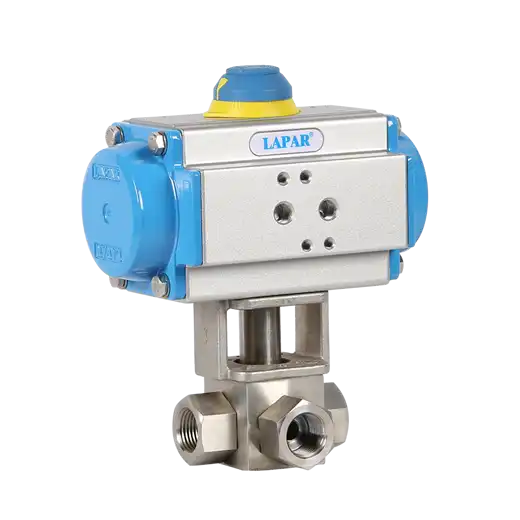
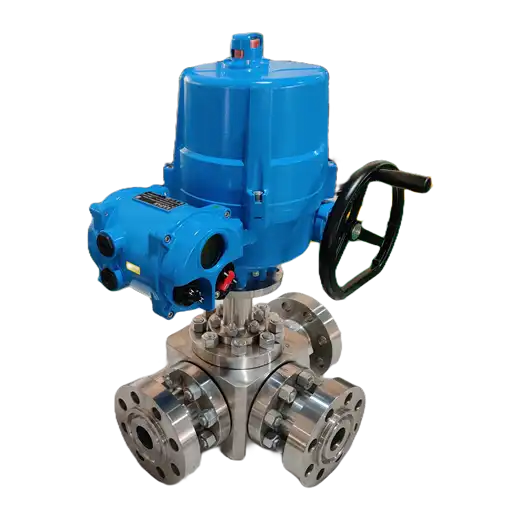
Three or four way multi port forged steel ball valve is a quarter-turn multiport valve that routes flow between three ports using an L-shaped or T-shaped bore through the ball, built on a forged body for high-pressure, small-bore service.
Product Description
Forging is the reason this valve exists in the form it does. A forged body is worked from solid stock, so the grain structure follows the contour of the part and there is no casting porosity to find during inspection. That matters most exactly where this valve is used: small bore, high pressure class, and service where a leak is not acceptable — instrument and sampling skids, production manifolds, chemical injection, high-pressure steam and condensate headers. Above roughly NPS 2 to NPS 4, depending on the design, casting becomes the economical route and the argument for forging weakens; below that, forging is the standard answer. Selecting a forged body is therefore a decision about pressure class, size and consequence of failure, not a general upgrade.d
The ball pattern is the decision that actually determines what the valve can do, and the two patterns are not substitutes. An L-port ball has a right-angle bore through the ball. It connects two ports at a time and never all three, so it diverts: flow in through the bottom, out to either side, or selected between two sources to one discharge. An L-port valve cannot connect all three legs simultaneously. A T-port ball has a T-shaped bore and opens up more combinations — all three ports connected, one port shut off while the other two pass, or crossover between legs — which is what makes mixing and bypass arrangements possible. T-port patterns also require more travel: some combinations need 180° rather than 90° rotation, and the stop positions have to be defined explicitly or the operator will find positions that connect lines that were never meant to be connected.
One boundary has to be stated plainly, because it is where this valve is most often misapplied: a multiport ball valve is a routing device, not a control valve. Parked at an intermediate angle, the edge of the ball shears across the seat, the split between the two outlet paths is unpredictable, and the seats erode. Flow coefficient figures published for these valves are full-open figures and have no useful meaning mid-travel. Where a duty genuinely needs proportioning between two paths — heat exchanger bypass temperature control, hot and cold blending to a setpoint — the correct device is a three way control valve with characterized trim, not a ball valve held at part rotation. If your requirement is to switch, select or divert, this valve is the right tool and the simpler one.
Two construction details separate a serviceable multiport ball valve from a problematic one. The first is the cavity: with some ports closed, process fluid can be trapped inside the ball cavity, and thermal expansion of that trapped liquid will build pressure the body was never sized for. Seats with a designed relief path, or an external cavity relief, address this. The second is stem retention and grounding: a blowout-proof stem and an antistatic path between ball, stem and body are baseline requirements on hydrocarbon and dry gas service, not options. Seat material then follows temperature — reinforced PTFE for the moderate band, PEEK or Devlon above it, metal seats where temperature or abrasive content rules polymers out entirely.
Key Features
- L-port or T-port ball patterns: diverting, mixing, crossover or single-port shutoff, with every stop position defined and detented so operators cannot land on an unintended combination.
- Forged body construction: wrought grain structure and no casting porosity, which is the reason for choosing forging over casting at small bore and high pressure class.
- Quarter-turn operation: 90° or 180° travel depending on pattern, with a direct-mount actuator pad for pneumatic or electric actuation.
- Blowout-proof stem and antistatic path: stem retained from inside the body, with electrical continuity between ball, stem and body — baseline for hydrocarbon and dry gas duty.
- Cavity pressure relief: seat design or external relief to handle trapped fluid in the closed ports, addressing thermal expansion load the body is not rated for.
- Seat materials matched to temperature: reinforced PTFE, PEEK, Devlon or metal seats selected against operating temperature and fluid abrasiveness rather than defaulted.
Typical Applications
- Refinery and petrochemical process switching — routing a stream between two destinations, or selecting between two sources into one header.
- Oil and gas production manifolds and gathering lines — compact forged multiport routing where pressure class is high and space on the skid is not.
- Chemical injection and sampling skids — small-bore diverting between injection, sampling and return paths with a single quarter-turn device.
- Duplex filter and strainer changeover — switching flow from the fouled side to the clean side without shutting the line down.
- High-pressure steam and condensate distribution — diverter duty on headers and branch takeoffs where a forged body is the standard choice.
- Utility and instrument air headers — crossover and bypass arrangements on plant and instrument air distribution.
The specification sequence for this valve is short and worth getting right: define whether the duty is diverting or mixing, which fixes the ball pattern; fix the pressure class and temperature, which fixes the body material and the seat; then confirm whether any port can be closed with fluid in it, which fixes whether cavity relief is required. Everything else — end connection, operator, actuator — follows from those three. Give us the port arrangement and the pressure and temperature conditions and we will confirm the pattern, seat and body material against them, rather than supplying a valve that happens to have three ports.
Technical Specifications
| Valve Size | NPS 1/2 – NPS 12 / DN 15 – DN 300 |
|---|---|
| Pressure Class | ASME Class 150 to 2500 |
| Operating Temperature | -29 to +200 °C / -20 to +390 °F soft seated |
| Process Connection | Flanged, Butt Weld, Socket Weld, NPT Threaded |
| Body Style | Three Way Ball — L-Port (diverting) and T-Port (mixing / crossover) |
| Body Construction | Forged, two-piece or three-piece |
| Body Material | Forged carbon steel, forged stainless steel, low-temperature carbon steel |
| Seat Material | Reinforced PTFE, PEEK, Devlon, Metal Seated |
| Stem Design | Blowout-proof stem, antistatic device |
| Operation | Lever, Gear, Pneumatic Actuator, Electric Actuator |
| Rotation | 90° (L-Port); 90° and 180° patterns (T-Port) |
| Design and Ratings | Buyers specify this valve type to API 608 or API 6D, ratings per ASME B16.34, ends per ASME B16.5 / B16.25 / B16.11 — list only what LAPAR documents support |
| Certifications | Fire-safe (API 607 / API 6FA), fugitive emissions (ISO 15848-1), sour service (NACE MR0175 / MR0103) — publish only where test reports exist |
| Media | Hydrocarbons, Gas, Steam, Condensate, Chemical Injection Fluids, Utility Air |
| Industries | Oil & Gas, Refining & Petrochemical, Chemical, Power, Process Skids & Metering |
Frequently Asked Questions
What is the difference between an L-port and a T-port three-way ball valve?
An L-port ball has a right-angle bore and connects two ports at a time, so it diverts flow or selects between two sources. It cannot connect all three legs at once. A T-port ball has a T-shaped bore and can connect all three ports, shut off one leg while the other two pass, or cross over between legs — which is what makes mixing and bypass arrangements possible. Some T-port combinations require 180° of travel rather than 90°.
Can a three-way ball valve be used for flow control or throttling?
No. Held at an intermediate angle, the edge of the ball shears across the seat, the split between the outlet paths is unpredictable, and the seats erode. Published flow coefficients apply at full open and have no useful meaning mid-travel. If the duty genuinely requires proportioning between two paths, specify a three way control valve with characterized trim instead.
Why choose a forged body instead of a cast body?
Forging is worked from solid stock, so the grain structure follows the part contour and there is no casting porosity. That matters at small bore and high pressure class, and on services where a leak is not acceptable. Above roughly NPS 2 to NPS 4, depending on design, casting becomes the economical choice and the advantage narrows.
What happens to fluid trapped in the ball cavity?
With some ports closed, process fluid can be trapped inside the ball. If that liquid heats up, thermal expansion builds pressure the body was not rated for. Seats with a designed relief path, or an external cavity relief, relieve that load to the upstream side. If your duty can leave fluid trapped with the valve closed, say so — it changes the seat specification.
Which seat material should be specified?
Reinforced PTFE covers the moderate temperature band and is the default for most hydrocarbon and utility duty. PEEK and Devlon extend the upper temperature range. Metal seats are specified where temperature exceeds what polymers survive, or where the fluid carries abrasive solids. Give us the operating temperature and fluid condition and we will match the seat to it.