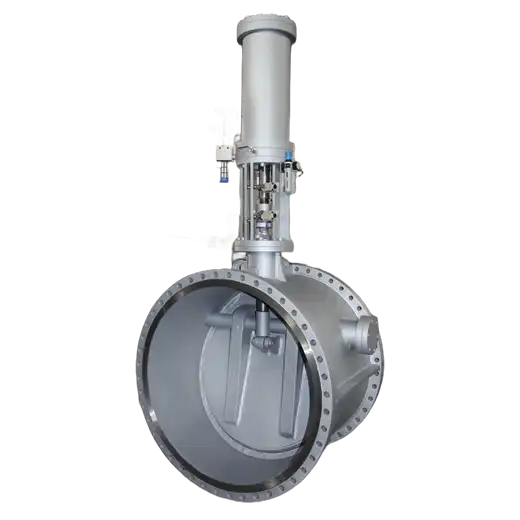
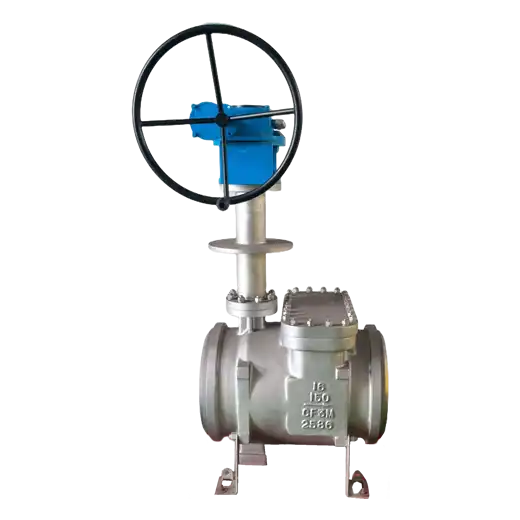
Triple offset cryogenic butterfly valve is a large bore shutoff valve for LNG and other cryogenic fluids, built to API 609 with an extended bonnet to BS 6364 and designed to hold zero leakage in both flow directions at temperatures down to -196 °C.
Product Description
Cryogenic service is not simply a cold version of ordinary service. At -196 °C most common valve materials lose toughness and become brittle, elastomers stop behaving as elastomers, and any part of the valve that holds pressure loses the generous safety margin it had at ambient temperature. That is why cryogenic lines use austenitic stainless steel bodies and stainless trim, why seat and packing materials are chosen from a short list that stays workable at low temperature, and why the valve must be tested cold before it is accepted.
The triple offset geometry is what makes this valve capable of metal to metal shutoff with a quarter turn. A concentric butterfly valve is limited because the disc rubs the seat through most of its travel, which is why those valves rely on soft seats and why they wear. Building three offsets into the design removes that rubbing. The first offset moves the stem axis behind the sealing plane, so the seat ring can be continuous rather than interrupted by the shaft. The second moves the stem off the pipe centerline, giving the disc a cam action that lifts it clear of the seat early in the opening stroke. The third inclines the seat cone axis away from the pipe axis, so the sealing contact occurs only at the final seated position. Sealing is then produced by torque rather than by interference, and nothing rubs during travel. Two consequences follow. Operating torque is low for the size and class, and seat life is long enough to justify a metal seat.
The second design decision is the bonnet. Its purpose is to distance the stem packing from the cold fluid, so that the gland and the packing operate near ambient temperature instead of at the temperature of the line. Without that distance, ice forms on the stem, packing stiffens and stops sealing, and the operator has to fight the valve. Extended bonnet length follows BS 6364, the specification written specifically for cryogenic valves, and MESC SPE 77/200, which is the length standard used on LNG terminal and plant projects. Together they also govern low temperature type and production testing, including helium leak testing at the minimum design temperature.
Bi-directional sealing is the third point, and it is the one that separates a well built cryogenic butterfly valve from an ordinary one. A triple offset design seals asymmetrically by its nature, and when pressure is applied against the non-preferential direction, the disc deflects away from the seat. Most designs answer that deflection with closing torque, which means a larger actuator and more wear. The floating seat arrangement answers it mechanically instead: the seat is free to move, it follows the disc, and it holds contact without demanding extra torque. Tightness is then obtained in both flow directions, not only in the preferred one.
Two valve constructions are available. Side entry takes the internals through the body side, which allows seat replacement and disc removal with the valve body still welded or bolted in the line. Double flange uses a flanged body bolted between pipe flanges. Both take either a soft seat in PCTFE for the tightest shutoff at the cost of temperature and fire performance, or a metal laminar seat of steel and graphite laminations for fire safe duty at higher temperatures. Where the valve is specified for butt weld ends, transition pieces are supplied so that the weld heat at site does not reach and damage the seat.
This valve is a shutoff valve for cryogenic lines. It is not a substitute for a cryogenic control valve: where you need modulated throttling of flow rather than isolation, specify a globe type cryogenic control valve with an extended bonnet and a trim selected for the duty.
Key Features
- Zero leakage in both flow directions: the floating seat compensates disc deflection, so shutoff does not depend on flow direction and does not require extra closing torque.
- Triple offset geometry: friction-free stroking through the whole travel, with contact only at the seated position, which is what allows a metal seat and gives long seat life.
- Extended bonnet to BS 6364 and MESC SPE 77/200: keeps the gland out of the cold zone so packing stays workable and ice does not form on the stem.
- Fire safe to API 607: metal seat and graphite based construction maintain shutoff after the fire test, which is normally mandatory on hydrocarbon service.
- Low fugitive emissions: quarter turn motion with a lip seal ring and graphite packing rings, with live loaded packing available where the specification requires it.
- Anti-blowout stem: a shouldered stem contains the stem even if the gland is removed while the valve is under pressure.
- Anti-static continuity: a spring loaded device bonds body and trim metallic parts so static charge cannot accumulate on the disc.
- Maintained in line: on the side entry design, internals come out through the side window and the disc can be withdrawn without removing the body from the pipeline.
Typical Applications
- LNG liquefaction plants: large bore isolation on cryogenic piping and headers.
- LNG and LPG carrier vessels and FPSOs: shutoff on cargo and transfer lines.
- Regasification terminals and peak shaving plants: storage, send-out and unloading lines.
- Ethylene and olefin plants: cold section isolation downstream of chilling trains.
- Air separation plants: liquid oxygen, nitrogen and argon lines, with oxygen service cleaning where required.
- Cryogenic storage tanks and loading facilities: tank isolation and transfer lines.
Selection here comes down to four questions: size and pressure class, minimum design temperature, choice between a PCTFE soft seat and a metal laminar seat, and the testing package the project requires. Those four determine everything else, including the extended bonnet length, so we size against the duty rather than against a catalogue page.
Technical Specifications
| Valve Type | Triple offset (triple eccentric) butterfly valve for cryogenic service |
|---|---|
| Body Design | Side entry, double flange |
| Valve Size | NPS 8 to 72 / DN 200 to 1800 |
| Pressure Class | ASME Class 150 to 600 |
| Design Temperature | Down to -196 °C |
| End Connections | Flanged (raised face), butt weld |
| Flow Direction | Bi-directional; zero leakage in preferential and non-preferential flow |
| Operation | Quarter turn actuators; handwheel, gear operator |
| Body Materials | ASTM A351 CF3, ASTM A351 CF3M, ASTM A351 CF8, ASTM A351 CF8C, ASTM A351 CF8M, ASTM A351 CK-3MCuN |
| Disc Materials | ASTM A351 CF8, ASTM A351 CF8M |
| Stem Materials | ASTM A479 Type 304, ASTM A479 Type 316, ASTM A479 XM-19HS |
| Gland Bushing and Flange Materials | ASTM A479 Type 304, ASTM A479 Type 316, ASTM A240 Type 316 |
| Fasteners | ASTM A320 Grade B8 Class 2, ASTM A320 Grade B8M Class 2, ASTM A194 Grade 8, ASTM A194 Grade 8A |
| Seat Options | Soft seat: PCTFE. Metal laminar seat: stainless steel and graphite laminations. Metallic seat ring hardfaced: Stellite 21 |
| Stem Packing | Lip seal ring, graphite packing rings, PTFE; live loaded packing available |
| Body Gaskets | Spiral wound stainless steel with graphite, lip seals, graphite |
| Design Standard | API 609 |
| Extended Bonnet | BS 6364, MESC SPE 77/200 |
| Fire Safe | API 607 |
| Inspection and Testing | API 598 shell and seat testing; low temperature type and production testing to BS 6364 |
| Safety Features | Anti-blowout stem, anti-static device |
| Weld End Protection | Transition pieces available for butt weld ends |
| Media | LNG, LPG, ethylene, oxygen, nitrogen, argon and other cryogenic fluids |
| Industries | Natural gas processing, petrochemical, chemical, power, LNG terminals and shipping |
Frequently Asked Questions
Why triple offset instead of a standard butterfly valve?
A concentric butterfly valve rubs its seat through most of the stroke, which limits it to soft seats and short life. The three offsets remove that contact during travel, so the valve can use a metal seat, needs torque only at the seated position, and operates with lower torque for its size and class.
Does it seal in both directions?
Yes, provided the seat is the floating type rather than a fixed one. Triple offset geometry seals asymmetrically by design, and pressure applied against the non-preferential direction deflects the disc away from the seat. A floating seat follows that movement instead of requiring extra closing torque against it.
Why is the bonnet so long?
To keep the stem packing out of the cold zone. BS 6364 and MESC SPE 77/200 set the extension length so that the gland operates near ambient temperature. Without it, the packing stiffens, ice forms on the stem, and the valve becomes hard to operate and starts leaking at the gland.
What do I need to specify about testing?
Two packages are customary. Factory hydrostatic shell and seat testing follows API 598. Cryogenic testing follows BS 6364, which covers type testing and production testing at low temperature with helium leak measurement, and it must be called out in the purchase order if the project requires it.
Soft seat or metal seat?
PCTFE soft seats give the tightest shutoff and suit clean, particle-free cryogenic service where a fire safe rating is not mandatory. Metal laminar seats tolerate higher temperature, survive dirty service and carry the API 607 fire safe rating, which hydrocarbon service usually requires.
Can the valve be serviced without taking it out of the line?
On the side entry design, yes. Internals are withdrawn through the side window and the disc can be removed with the body still in the line, so a seat replacement does not mean cutting the valve out of the pipe.
Resources
Data Sheets:
Manuals: IOM
Product Photos: