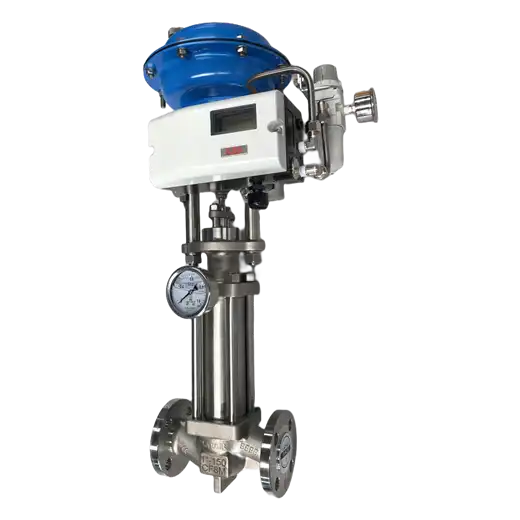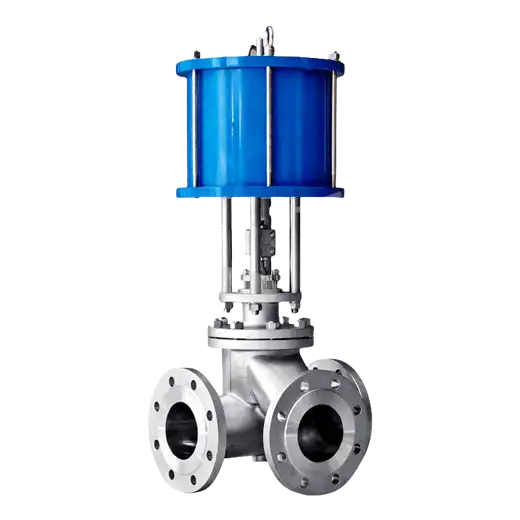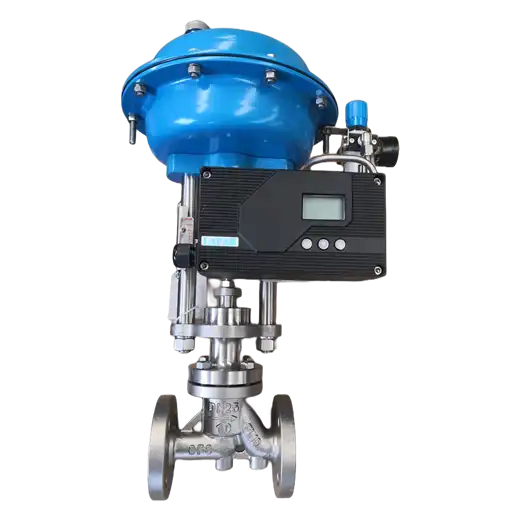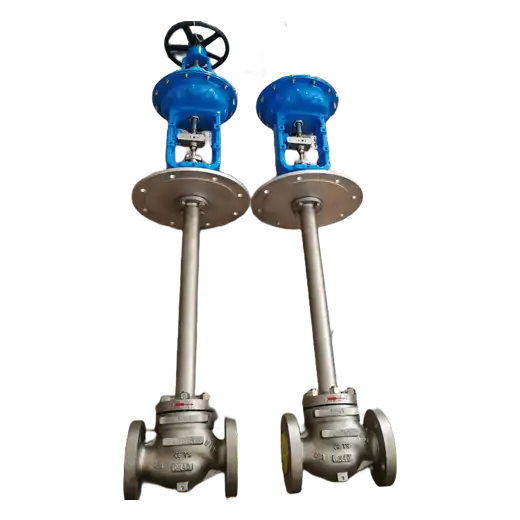
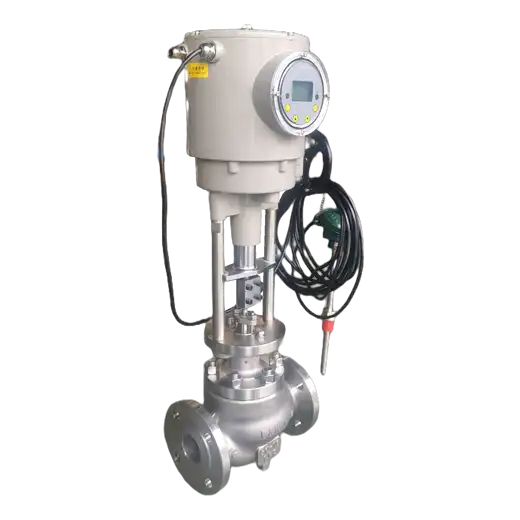
The electric temperature control valve is a globe or rotary valve driven by a motorised actuator and modulated by an electronic controller that reads a temperature sensor in the process.
Product Description
Temperature is a slow, laggy variable. Heat takes time to travel through a heat exchanger wall and through the fluid itself, so by the time the sensor sees a deviation, the correction has to act against a process that has already moved further. An electric control arrangement handles this by putting the control logic where it can actually do something about lag: a controller reads the sensor, evaluates the deviation, and drives the actuator to a position rather than simply opening or closing. Modulating position — rather than two-state action — is what keeps a loop from oscillating around its setpoint.
The distinction worth being explicit about is between this valve and our self-acting temperature regulator. The self-acting unit takes its energy from the process itself and needs no external power, which makes it attractive for remote locations and simple duties. The cost of that simplicity is a narrower proportional band and a setpoint changed at the valve rather than from a control room. An electric valve reverses that trade: it needs a power supply and a controller, and in exchange it gives a setpoint that can be changed remotely, a controller that can be tuned to the actual loop dynamics, and an actuator that can be asked to hold any intermediate position reliably.
That trade has practical consequences for where each belongs. Where the temperature tolerance is generous, the duty never changes, and there is no power at the point of use, the self-acting regulator is usually the right answer and usually cheaper over its life. Where the tolerance is tight, the setpoint changes by recipe or by product, the loop needs tuning against a known lag, or the valve is part of a plant-wide control system that wants a standard signal, the electric version earns its cost. Choosing incorrectly in either direction costs more than the valve: undersizing the control capability gives chronic instability, and oversizing it pays for capability never used.
A note on what the actuator actually delivers. Rotational travel in a motorised actuator converts to linear stem travel for a globe body through a drive train, and the stiffness of that train determines how well the valve holds position against changing differential pressure. Where the process pressure varies substantially across the stroke, this is the specification item worth asking about — it governs whether a given stem position reliably produces the flow the controller expects.
Key Features
- Modulating electronic control: the actuator is positioned continuously by a controller rather than stepping between open and closed, which is what allows a laggy temperature loop to settle.
- Remotely setable setpoint: the temperature target can be adjusted from the controller or the control system, rather than requiring access to the valve.
- Tunable to loop dynamics: control parameters can be set against the actual lag of your process, which matters because every exchanger and vessel has a different response.
- Standard signal compatibility: integrates with common control interfaces and instrumentation, so the valve behaves like any other device in the loop rather than requiring a bespoke interface.
- Defined fail position: the assembly can be specified to move to a stated position on loss of signal or power — a requirement of the process, not an optional feature.
- Globe or rotary execution: a globe body for throttling accuracy, or a rotary body where compactness and higher capacity are the priority.
Typical Applications
- Heat exchanger outlet temperature control — modulating steam or hot water to hold a process outlet temperature against changing flow and inlet conditions.
- Reactor jacket heating and cooling — recipe-driven temperature profiles where the setpoint changes through the batch cycle.
- Thermal fluid systems — regulating circulation of hot oil to hold a uniform supply temperature across multiple users.
- HVAC and district energy — substation temperature control where the setpoint is managed remotely by an energy management system.
- Food and beverage process heating — pasteurising, cooking and holding duties where temperature deviation is a product quality defect.
Temperature control failures are usually blamed on the valve when the real problem is that nobody characterised the loop. Ask how much lag sits between the valve and the sensor, how widely the differential pressure moves across the stroke, and what happens on power loss. Those three answers determine whether an electric control valve is the correct specification, whether the self-acting version would do the job more economically, and what fail position the process actually requires. Supply them at enquiry and the selection is straightforward. Supply only a line size and a temperature, and the result is guesswork.
Technical Specifications
| Valve Size | NPS 1/2 – NPS 12 / DN 15 – DN 300 |
|---|---|
| Pressure Class | ASME Class 150 to 600; DIN PN16 to PN100 |
| Operating Temperature | -20 to +450 °C / -4 to +840 °F |
| Body Style | Globe (Straight), Angle, Three Way, Rotary |
| Process Connection | Flanged, Threaded, Butt Weld, Socket Weld |
| Trim | Contoured plug; characterised to the control requirement |
| Seat Leakage | Class IV, Class V, Class VI per ANSI/FCI 70-2 |
| Flow Characteristics | Linear, Equal Percentage, Quick Open, Custom |
| Actuator | Electric Motorised Actuator — modulating |
| Control Signal | 4–20 mA, 0–10 V, Hart, Modbus, and others available |
| Position Feedback | Analog / digital feedback, limit switches |
| Fail Action | Fail-Open, Fail-Closed, Fail-in-Position — must be specified at order |
| Power Supply | 24VDC, 230VAC, 380VAC, 50/60Hz, custom |
| Critical Service | Temperature Control, Heat Exchange, Reactor Jacket, Thermal Fluid, HVAC |
| Certifications | CE, ATEX on request |
| Media | Steam, Hot Water, Thermal Oil, Cooling Water, Process Liquids |
| Industries | Chemical & Petrochemical, Power, HVAC & District Energy, Food & Beverage, Pharmaceutical |
Frequently Asked Questions
How does this differ from a self-acting temperature control valve?
A self-acting valve takes the energy to modulate from the process medium itself and needs no external power, but its proportional band is narrower and its setpoint is adjusted at the valve. An electric valve requires power and a controller, and in return gives a remotely setable setpoint, tunable control against the actual loop lag, and reliable intermediate positioning. If the tolerance is loose and the duty never changes, the self-acting unit is usually the more economical choice.
When do I genuinely need electric rather than self-acting?
When the temperature tolerance is tight, the setpoint changes by recipe or product, the loop has enough lag that it needs tuning, or the valve has to be integrated into a plant control system. Those conditions cannot be met by a purely mechanical regulator. Where none of them apply, electric control pays for capability the process will not use.
Why does my temperature loop oscillate?
Usually because the lag between the valve and the sensor exceeds what the controller settings assume, or because the valve gains a different behaviour at different openings. Both are addressed by tuning against the real loop rather than default parameters. Occasionally the valve is simply oversized and operates almost closed, where a small movement produces a large change in flow.
What happens to the valve if power is lost?
That depends on the fail action specified at the time of order — open, closed or in place. It is determined by what your process needs on failure, and it must be stated at enquiry, because it is built into the actuator rather than settable later.
Can this integrate with my existing control system?
The valve takes standard industrial control signals, so integration depends on matching available interfaces rather than on custom hardware. Provide the signal type and protocol your system uses, and we will confirm the actuator version that supports it.
Resources
Data Sheets:
Manuals: IOM
Product Photos: