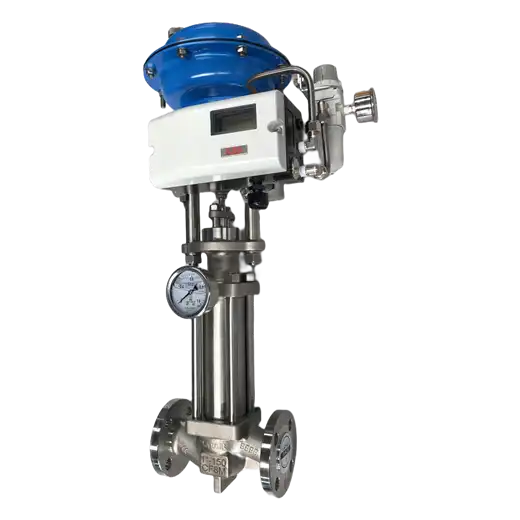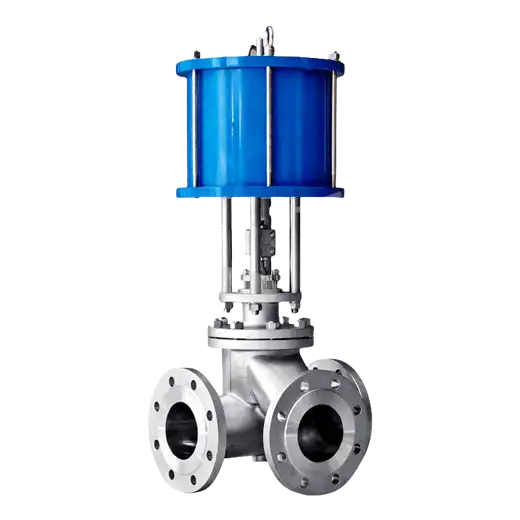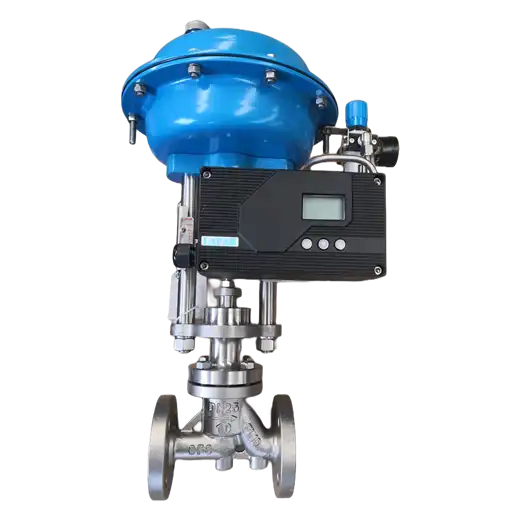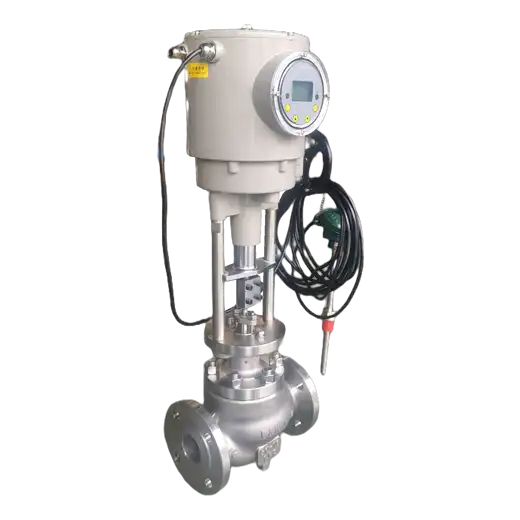
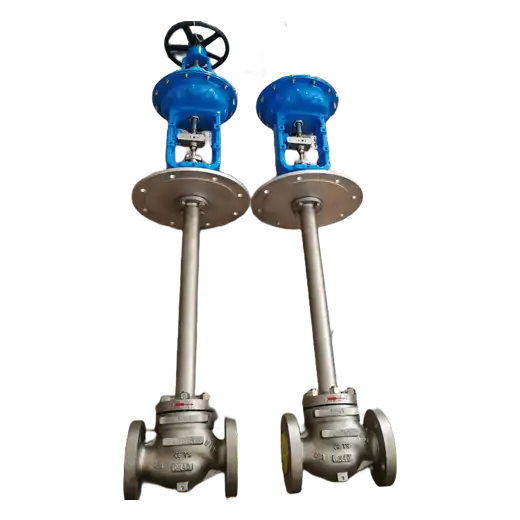
The cryogenic control valve throttles liquefied gases at temperatures where ordinary body materials lose toughness, ordinary elastomers harden, and ordinary stem packing freezes solid.
Product Description
Cryogenic service is not simply cold service. Below a certain threshold, carbon steel loses impact toughness and turns brittle, elastomers stop sealing, and standard PTFE packing contracts away from the stem. A valve that modulates cleanly at ambient conditions can seize, leak at the gland, or crack under thermal shock at LNG temperatures. Every component — body, trim, packing, gaskets and fasteners — has to be selected against the stated minimum design temperature rather than against the ambient. Because that threshold depends on the actual material specified, confirm the minimum metal temperature for your selected body and trim before finalising the material.
The defining detail is the extended bonnet. The stem must carry motion from a body sitting at cryogenic temperature up to an actuator at ambient temperature, and the length of that column governs how much cold migrates upward. The extension does three jobs at once: it moves the packing box far enough out of the cold zone that the packing stays above its usable temperature; it provides a vapour column so boil-off gas buffers the gland instead of sitting directly on it; and it gives a horizontal-bodied valve somewhere for liquid to vaporise without dragging the packing temperature below its limit. Getting this length wrong is the most common cause of a frozen stem in the field, and it cannot be corrected by repacking.
Material selection is the second pillar. Bodies are normally austenitic stainless castings, with trim in stainless grades that retain impact strength at temperature. The weakness is almost never the body — it is the joint: bonnet fasteners, gaskets and stem packing must all carry the same temperature rating, or the body survives and the bonnet weeps. Seat leakage is specified against ANSI/FCI 70-2, and where a tighter class is required the soft seat material has to be compatible with the minimum temperature as well as with the flowing medium. Achievable class depends on size and trim configuration, so state the requirement per port rather than accepting a blanket figure.
One further point that separates this page from our general low-temperature products: this valve handles the process fluid itself at cryogenic temperature. It is not a jacketed valve holding a hot or viscous medium at working temperature, and it is not an ambient valve feeding a cold line. It is a throttling valve whose entire pressure boundary, stem seal and guidance have to remain functional while the body sits at or below the boiling point of the process fluid.
Key Features
- Extended bonnet geometry: column length set to place the packing box outside the cold zone, keeping the seal above its usable temperature during continuous operation.
- Vapour column design: the extension provides a stable gas buffer so evaporated process fluid does not sit directly on the gland.
- Austenitic stainless pressure boundary: body and trim in stainless grades selected for retained impact toughness at low temperature, not merely for corrosion resistance.
- Low-temperature-rated sealing set: packing, gaskets and fasteners specified to the same minimum metal temperature as the body — the joint is not allowed to be the weak link.
- Cleanable drainage geometry: body forms arranged so the valve does not trap liquid that would vaporise unpredictably on start-up or during shutdown.
- Standard automation interface: accepts pneumatic diaphragm, piston or electric actuators, with no requirement for custom mounting hardware.
Typical Applications
- LNG transfer and regasification — throttling liquefied natural gas at transfer lines, loading arms and vaporiser feed.
- Air separation units — control of liquid nitrogen, liquid oxygen and liquid argon on production and storage duty.
- Liquefied gas storage systems — tank inlet, circulation and withdrawal control on cryogenic storage of industrial gases.
- Process refrigeration loops — throttling ethylene, propylene and other liquefied refrigerants where the valve sits in the cold stream.
- Cryogenic test and research installations — precise modulation on pilot plants and test rigs operating far below ambient.
A cryogenic control valve succeeds or fails on details that are invisible once installed — bonnet length, packing box temperature, and whether every fastener in the joint carries the same rating as the body. Those are decisions made at specification time, not ones a positioner can compensate for later. Give us the minimum design temperature, the fluid and the duty cycle, and we will size the extension, select the material set and state the achievable leakage class for that specific configuration. Everything else follows from those three inputs.
Technical Specifications
| Valve Size | NPS 1/2 – NPS 8 / DN 15 – DN 200 |
|---|---|
| Pressure Class | ASME Class 150 to 600; DIN PN16 to PN100 |
| Operating Temperature | -196 to +80 °C / -320 to +175 °F |
| Process Connection | Flanged (RF / RTJ), Butt Weld, Socket Weld |
| Body Style | Globe (Straight), Angle, Three Way on request |
| Bonnet | Extended Bonnet for Cryogenic Service, Vacuum Jacketed option |
| Body Material | Austenitic Stainless Steel — CF8 / CF8M / CF3M |
| Trim | Full stainless trim; characterised plug with soft or metal seat |
| Stem Seal | Low-temperature packing set |
| Seat Leakage | Class IV, Class V, Class VI per ANSI/FCI 70-2 (dependent on trim and temperature) |
| Flow Characteristics | Linear, Equal Percentage, Quick Open, Custom |
| Critical Service | Cryogenic, LNG, Air Separation, Liquefied Gases, Refrigeration |
| Actuator | Pneumatic Diaphragm, Piston, Electric |
| Accessories | Positioner, Position Transmitter, Limit Switch, Solenoid Valve, Air Lock Relay, Air Filter Regulator |
| Certifications | PED, ATEX, SIL capable |
| Media | LNG, Liquid Nitrogen, Liquid Oxygen, Liquid Argon, Refrigerant Liquids |
| Industries | Oil & Gas, Industrial Gas, Petro-Chemical, Refrigeration, Research |
Frequently Asked Questions
What makes a control valve cryogenic rather than just low temperature?
A cryogenic valve is built so its materials retain toughness, and its stem seal stays operational, at temperatures where ordinary carbon steel embrittles and standard packing freezes. That requires an extended bonnet to distance the packing box from the cold zone, plus a material set rated to the stated minimum design temperature. A standard low-temperature valve without those measures cannot be assumed capable of continuous cryogenic throttling.
Why is the extended bonnet necessary?
It carries three functions. It moves the packing box out of the cold zone so the packing remains usable, it creates a vapour column so evaporated fluid buffers the gland rather than freezing it, and it gives liquid somewhere to vaporise without dragging the seal temperature down. Insufficient extension length is the most common cause of a frozen stem, and it cannot be fixed by changing packing material afterwards.
What temperature can this valve handle?
The limit is set by the minimum design temperature of the selected body and trim materials, not by a single number for the whole product line. Give us the fluid and the minimum operating temperature, and we will confirm the applicable material set and the achievable leakage class for that combination. Do not assume the maximum rated figure applies across all sizes and trim variants.
Can I use a standard control valve on a cryogenic line?
Not reliably. Even if the body survives the initial cooldown, the packing will contract and leak at the gland, elastomers may harden, and fasteners may not be rated for the temperature. Standards exist for cryogenic valve verification; if your duty genuinely sits at cryogenic temperature, the extension geometry and material selection are not optional upgrades — they are the requirement.
Is oxygen service different from nitrogen service?
Yes. Liquid oxygen requires degreased, oxygen-clean assembly with materials compatible with enriched oxygen, since hydrocarbon contamination becomes a serious ignition risk. Assembly, cleaning and packaging procedures all change. Always declare oxygen service explicitly at enquiry so the cleaning procedure is applied before the valve leaves the factory.
Resources
Data Sheets:
Manuals: IOM
Product Photos: