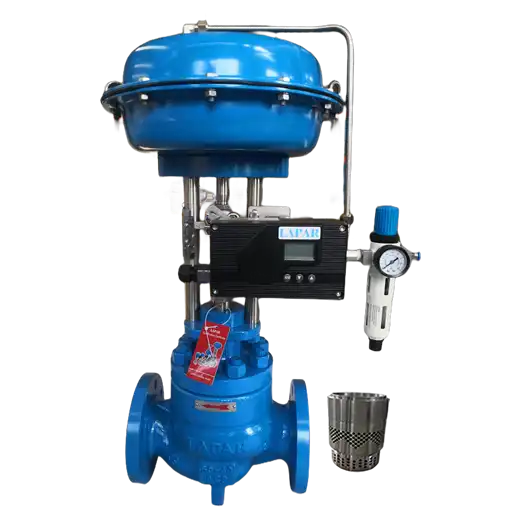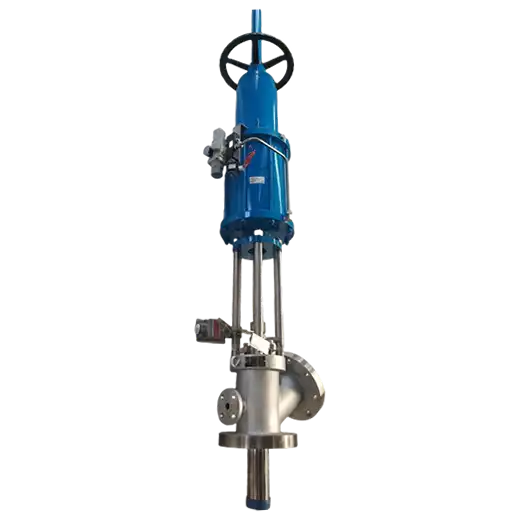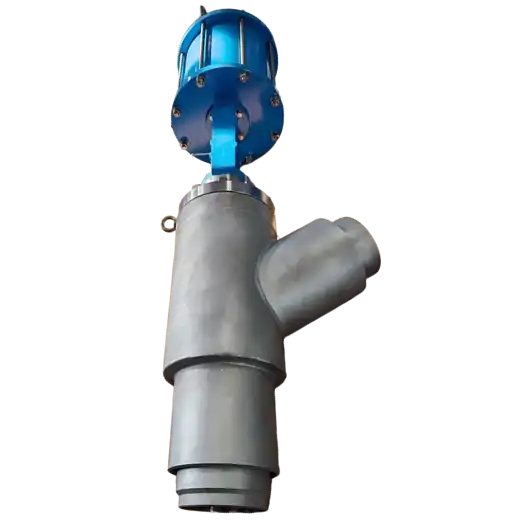
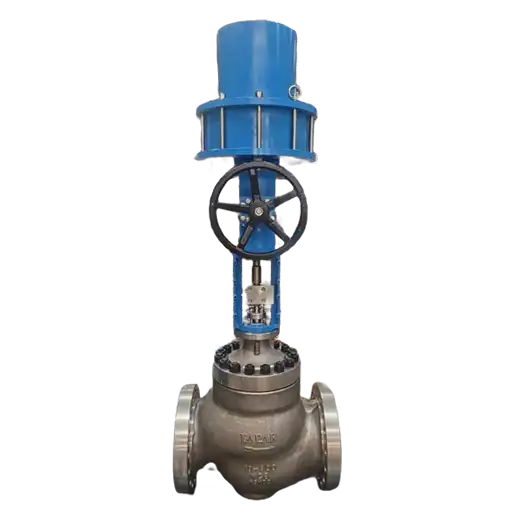
High pressure multi-stage control valve throttles fluids across very large pressure differentials by breaking that drop into a series of smaller steps, so no single restriction absorbs the whole energy release.
Product Description
Every throttling valve dissipates the energy it removes from the fluid. At low differential that dissipation is unremarkable. At the differentials found in feedwater, high-pressure letdown and high-pressure gas service, the amount of energy released per unit volume is large enough to destroy conventional trim quickly, generate serious noise, and set up vibration that damages piping as much as the valve. Increasing the size of a single-stage valve does not solve it — the energy still has to be dissipated, and concentrating it in one restriction is precisely what causes the damage.
Staging changes the arithmetic. Instead of one drop from upstream to downstream pressure, the fluid passes through a sequence of restrictions, each taking a portion of the total. Because pressure partially recovers between stages, downstream restrictions work at less severe local conditions, and the final velocity is lower than a single-stage valve would produce. The practical results are longer trim life, lower noise, and reduced vibration — which is usually what is noticed first on site, because pipe supports and instrumentation fail long before the valve does.
The high-pressure aspect deserves separate treatment because it is not the same requirement as staging. A body has to contain the pressure, which makes wall thickness, bonnet joint design, bolting and material selection fundamentally different from a standard Class 300 body. The governing rating system — ASME B16.34 for pressure-temperature ratings — determines what the body is permitted to contain at a given temperature, and that rating, not the nominal class stamped on a lower-pressure product, defines whether this valve belongs in the position. Combining that pressure containment with staged trim is what distinguishes this model from either requirement met alone.
How this differs from adjacent products: our multi-stage trim anti-cavitation valve addresses cavitation damage and noise in liquid service across the plant generally, and is the right place to start when the problem is bubble collapse. Our high pressure single seated valve handles high pressure where the differential does not demand staging. This model sits where both conditions apply simultaneously — high contained pressure and enough differential that a single-stage trim would not last. Where the differential comes from steam flashing specifically, our power plant drain control valve is the more targeted answer.
Key Features
- Multi-step pressure reduction: the differential is divided across a series of restrictions, with interstage recovery reducing the severity at each downstream stage.
- Heavy-section body to pressure class: body, bonnet and bolting dimensioned against the pressure-temperature rating rather than merely matching a nominal size.
- Lower generated noise: distributing the pressure drop reduces the aerodynamic and hydrodynamic noise produced at a single restriction — quantify against your own duty rather than accepting a generic figure.
- Reduced vibration: staged letdown lowers the mechanical excitation transmitted into piping, protecting supports, instrumentation and adjacent equipment.
- Replaceable trim cartridge: staged trim assemblies designed for changeout without disturbing the body, so maintenance happens at the trim rather than at the pipeline.
- Full actuation compatibility: accepts pneumatic piston or electric actuation sized for high differential thrust requirements.
Typical Applications
- Boiler feedwater and start-up circuits — throttling high pressure feedwater where differential would destroy single-stage trim.
- High pressure heater drain service — letdown from heater pressure to a lower pressure level with staged control.
- High pressure gas letdown — controlled reduction on gas streams where noise and vibration are limiting factors.
- Superheated steam letdown attemperator supply — staged control on high pressure steam supply duties.
- High pressure water injection systems — controlled injection where contained pressure is high and throttling differential is severe.
Specifying for high differential is a question of energy, not pressure class alone. Two installations can carry the same upstream pressure and be utterly different duties depending on what happens downstream, and choosing by class rather than by differential is how valves get replaced every outage. Tell us upstream pressure and temperature, downstream pressure, required flow range and the medium, and we will size the staging and confirm the body rating required. If single-stage trim would actually suffice, we will say so — staging that is not needed only adds cost and pressure drop capacity you never use.
Technical Specifications
| Valve Size | NPS 1 – NPS 16 / DN 25 – DN 400 |
|---|---|
| Pressure Class | ASME Class 900, 1500, 2500 per ASME B16.34 |
| Operating Temperature | -29 to +590 °C / -20 to +1100 °F |
| Body Style | Globe (Straight), Angle, Y-Pattern, Fabricated |
| Process Connection | Butt Weld, Flanged (RTJ), Grayloc Hub, Compact Flange |
| Body Material | Alloy Steel, Stainless Steel |
| Bonnet | Standard, High Temperature (Extension / Finned), Cryogenic |
| Trim Type | Multi-Stage Trim — labyrinth disk, stacked plate, drilled cage or diffuser |
| Trim Material | Hardened Stainless Steel, Stellite |
| Stem Seal | Graphite Packing; bellows seal available |
| Seat Leakage | Class IV, Class V per ANSI/FCI 70-2 |
| Flow Characteristics | Linear, Equal Percentage, Custom |
| Critical Service | High Pressure Drop, Severe Service, Feedwater, Heater Drain, High Pressure Gas Letdown |
| Actuator | Pneumatic Piston, Pneumatic Diaphragm, Electric, Hydraulic |
| Accessories | Positioner, Position Transmitter, Limit Switch, Solenoid Valve, Air Lock Relay, Volume Booster |
| Certifications | ASME, PED, ATEX, SIL capable |
| Media | Feedwater, Boiler Water, Steam, High Pressure Gases, Condensate |
| Industries | Power Generation, Oil & Gas, Chemical & Petrochemical, Refining |
Frequently Asked Questions
When do I need multi-stage trim rather than a single-stage high pressure valve?
When the differential across the valve is large enough that the energy released at one restriction erodes the trim, generates unacceptable noise, or sets up damaging vibration. A high pressure rating alone does not answer it — our high pressure single seated valve covers high contained pressure where the differential does not demand staging. Give us both pressures and the flow and we will tell you which applies.
How many stages does my duty need?
Stage count follows the total differential and the medium, not a fixed configuration. It is determined during selection from your pressure conditions. Supplying upstream pressure, downstream pressure and flow range allows the staging to be set correctly rather than guessed.
Is this the same as an anti-cavitation control valve?
Related, but the emphasis differs. Where the primary problem is cavitation damage and its associated noise in liquid service, see our multi-stage trim anti-cavitation valve. This model is specified where high contained pressure and extreme differential must both be handled, and body rating becomes as important as trim design.
Does staging reduce noise?
Yes — distributing the pressure drop lowers the noise generated at any single restriction. How much is specific to your duty and should be calculated against your actual conditions, rather than taken from a general claim. Tell us your noise limit and we will assess whether staging alone is sufficient.
Will ASME B16.34 rating alone guarantee suitability?
The rating defines what the pressure boundary may contain at a given temperature; it does not say anything about whether the trim will survive the differential. Both have to be satisfied, and they are evaluated separately. A valve can be correctly rated for pressure and still fail quickly if the drop is not staged.