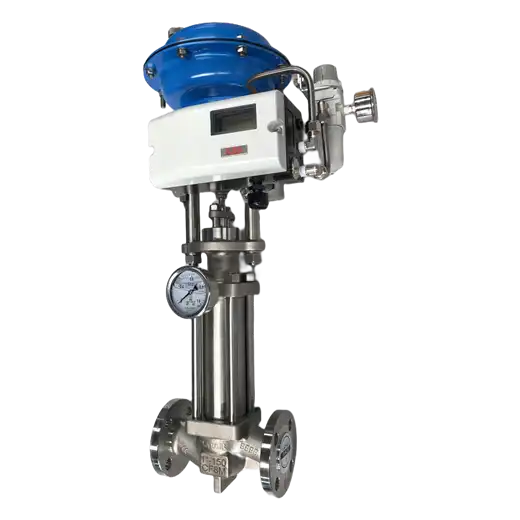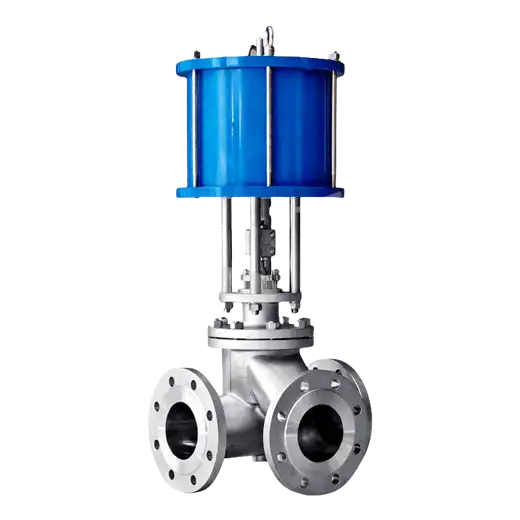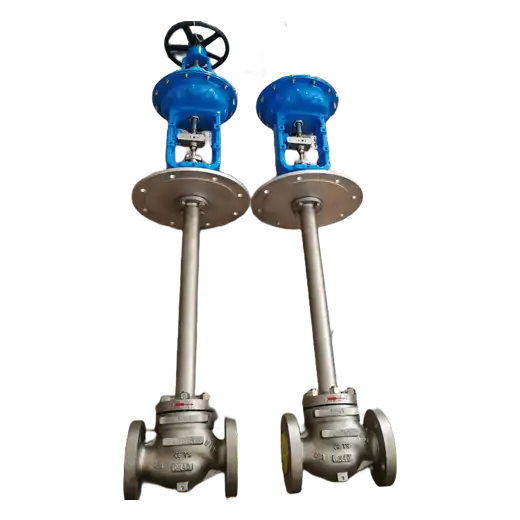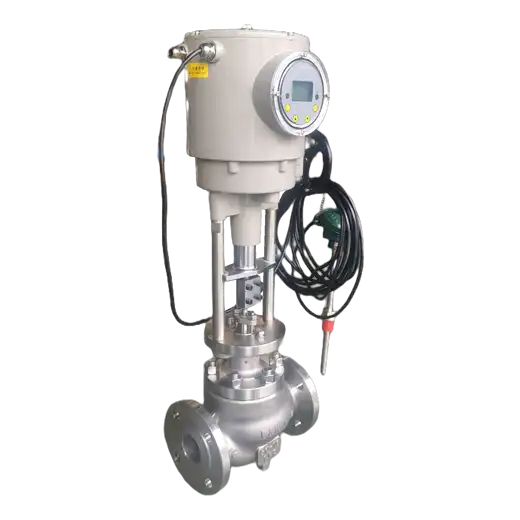
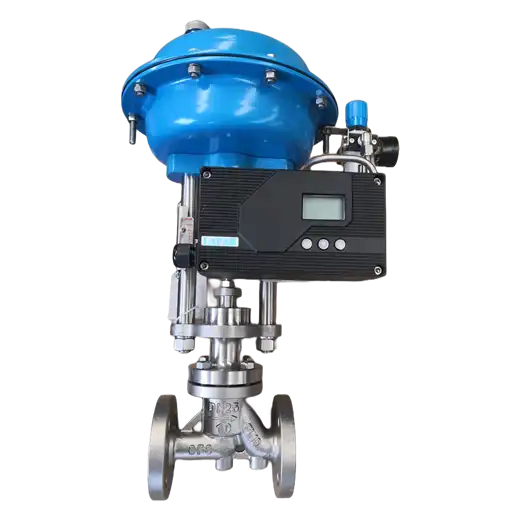
The antibiotic control valve is the actuated version of the fermentation multi-function valve: it regulates flow continuously under a control signal while keeping the same zero dead space body that prevents material from surviving between batches.
Product Description
The multi-function fermentation valve already throttles when operated by hand. What it does not do is hold a commanded position accurately against varying conditions, or respond to a signal from a control system. That is the gap this valve fills. It keeps the body concept — no dead space, stem thread kept clear of the medium, double shut-off with hardened surfaces — and adds guided characterised trim driven by an actuator, so intermediate positions are repeatable rather than approximate.
That addition introduces the difficulty this valve has to solve. A trim assembly means more internal parts, and every additional part is a candidate pocket where material could shelter. Adding automatic regulation to a hygiene-driven design therefore tends to work against the reason the design exists. This valve addresses it by carrying the zero dead space geometry through the trim region rather than treating it as a separate concern, so the control function does not quietly reintroduce the accumulation surfaces the body was designed to eliminate.
Control behaviour follows conventional principles. The plug is guided so it stays centred through its travel, because a plug that shifts centre changes the flow relationship as it moves — and a controller cannot be tuned reliably against a characteristic that varies with position. Guidance also suppresses the vibration that appears at partial openings, which is otherwise a steady source of trim wear and erratic control. The actuator must hold position against changing differential across the stroke, which makes thrust capability rather than stroke alone the selection criterion.
Sealing and temperature follow the same tiers as the hand-operated version, and this is usually the deciding question at specification. A standard PTFE sealing set is suited to roughly 120 °C, a high-temperature PTFE set to about 200 °C, and a PPL set to around 400 °C. Since fermentation lines routinely steam for cleaning and sterilising, the right tier depends on what actually happens during those cycles rather than on the normal process temperature. Getting it wrong produces either early seal failure or unnecessary cost. [TBC — confirm LAPAR offers these tiers on the control valve version]
Where each belongs: the hand-operated multi-function valve suits isolation and manual throttling. This one suits automated continuous modulation — feed regulation, temperature control loops, or any position under a control signal. And as with every product in this family, this is a flanged industrial valve, not a clamp-ended polished hygienic valve built to a stated roughness value.
Key Features
- Zero dead space through the trim region: the no-pocket geometry is carried into the trim area, so automatic regulation does not reintroduce the accumulation surfaces the body design removes.
- Stem thread isolated from the medium: the threaded stem portion never contacts process media through the stroke, eliminating a retention point that cleaning cannot reliably reach.
- Guided characterised trim: plug remains centred through travel, keeping the installed characteristic consistent and suppressing vibration at partial openings.
- Double shut-off with hardened surfaces: two independent sealing lines, optionally laser-clad with cobalt or nickel base alloy for wear resistance. [TBC]
- Selectable sealing tier: PTFE, high-temperature PTFE or PPL, matched to your cleaning and sterilising temperatures rather than defaulted. [TBC]
- Actuation for true modulation: pneumatic diaphragm, piston or electric actuation with the accessories a modulating loop requires.
Typical Applications
- Fermenter feed regulation — controlled addition of culture medium, nutrients or air into a vessel under automatic control.
- Fermentation temperature loops — modulating steam, water or cooling to jacket or coil duty against a temperature signal.
- Pressure control in vessels and lines — holding line or vessel pressure automatically rather than by hand.
- Downstream recovery and purification — controlled transfer and proportioning through recovery operations.
- Brewing, amino acid and enzyme fermentation — automated duty where the same contamination economics apply.
Every actuated position on a fermentation line trades control capability against additional internal geometry, and that geometry is precisely where contamination begins. Specify with that trade visible. Give us the medium, the required flow range, inlet and outlet pressures across the stroke, and above all your cleaning and sterilising temperatures — the last determines the sealing tier, and choosing it wrongly is the most common cause of premature failure on these lines. If your conditions exceed what the family covers, we will tell you before you buy.
Technical Specifications
| Valve Type | Flanged Globe Control Valve for Fermentation Service, Actuated Modulating |
|---|---|
| Valve Size | DN15~DN300 |
| Nominal Pressure | PN 16 |
| Working Temperature | Standard PTFE ~120 °C; custom |
| Body Material | Stainless Steel 304 / 316L |
| Process Connection | Flanged |
| Trim Type | Guided contoured or characterised plug |
| Sealing Set | PTFE gasket, body mid-joint seal and stem packing |
| Shut-Off Type | Double shut-off — conical face followed by flat face contact |
| Stem Isolation | Stem thread held clear of the medium through full travel |
| Internal Geometry | Zero dead space through trim region |
| Drain / Vent Port | Bottom port available on request |
| Seat Leakage | Class V, Class VI, tight shutoff |
| Flow Characteristics | Linear, Equal Percentage, Custom |
| Actuator | Pneumatic Diaphragm, Piston, Electric |
| Accessories | Positioner, Position Transmitter, Limit Switch, Solenoid Valve, Air Filter Regulator |
| Media | Steam, Water, Culture Medium, Air |
| Industries | Antibiotic & Pharmaceutical, Amino Acid Fermentation, Brewing, Bio-Pesticide, Bio-Fertilizer, Enzyme & Food Fermentation, Biochemical |
Frequently Asked Questions
How is this different from the antibiotic globe valve?
The globe valve combines shut-off, throttling and diaphragm isolation in one manually operated body and covers isolation and occasional regulation well. This control valve is built for continuous automatic modulation — it takes a control signal and holds intermediate positions accurately. Choose by whether the position is operated by hand or by the control system.
Why does automatic control create a hygiene problem?
Because it requires additional trim parts, and each part is a potential pocket where material survives cleaning. This valve carries the zero dead space geometry through the trim region so that regulation does not reintroduce the accumulation surfaces the body was designed to eliminate.
Which sealing tier do I need?
It depends on your cleaning and sterilising temperatures rather than your normal process temperature. Fermentation lines steam regularly, and that cycling sets the requirement. Tell us the actual cycle conditions and we will match the tier; guessing gives early seal failure or unnecessary cost.
Does the plug need to be guided?
Yes. An unguided plug shifts as it travels, changing its flow characteristic with position, and no amount of controller tuning compensates for a valve whose behaviour moves. Guidance also suppresses vibration at partial openings, which otherwise wears trim and destabilises the loop.
What should I include at enquiry?
Medium, required flow range, inlet and outlet pressures across the stroke, and your cleaning and sterilising temperatures. Without the temperature cycling data, the sealing selection is a guess.
Resources
Data Sheets:
Manuals: IOM
Product Photos: