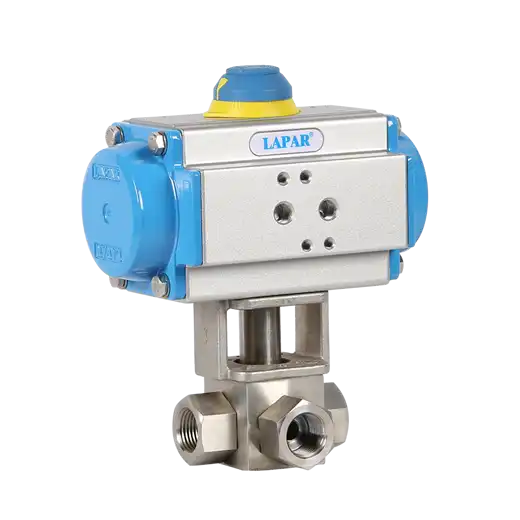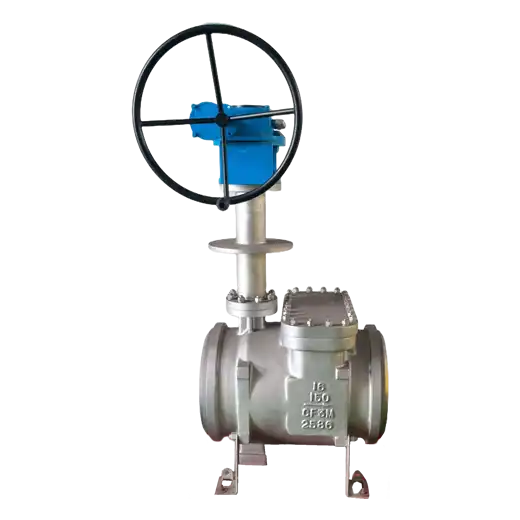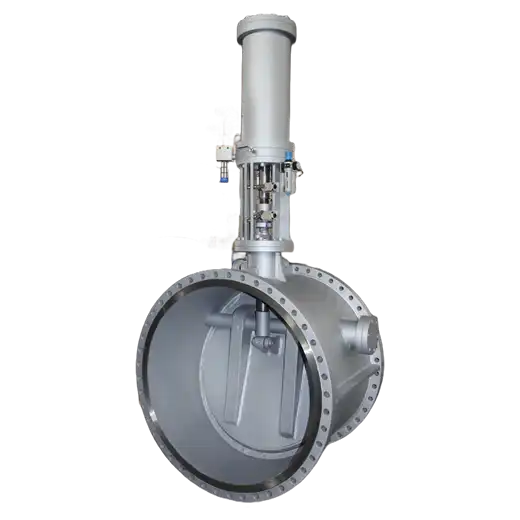
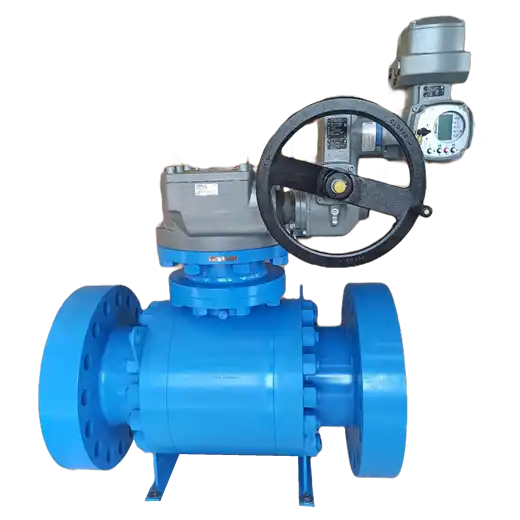
Trunnion ball valve is a quarter-turn isolation valve in which the ball is anchored at top and bottom by trunnions, so line thrust is carried by bearings rather than pressed into the downstream seat. It is built to cut off or to put into service lines rated ASME Class 150 through Class 2500 in sizes from NPS 2 to NPS 48, and its job is isolation rather than regulation.
Product Description
Everything about this design follows from that one mechanical difference. In a floating ball valve, the ball is held only by its stem and is free to move slightly downstream. Upstream pressure pushes it onto the downstream seat, and that contact load is what makes the seal. It is a simple, effective arrangement, and it is why floating valves dominate general industrial service at small sizes and moderate pressure. The cost of that simplicity is that contact load grows directly with differential pressure and with ball area, so break-to-open torque climbs steeply as either increases.
A trunnion mounted ball valve anchors the ball instead. A trunnion, or bearing plate, locates the ball from below and the stem drives it from above, and the two together take the thrust that line pressure generates. The seats are spring or pressure energized rings that travel axially onto a ball that is not going anywhere. Because the load path runs through bearings rather than through the seats, torque becomes nearly independent of line pressure and tracks valve size and seat friction instead of the product of pressure and area. The practical consequences are worth stating plainly: the actuator is smaller, the stem is not being asked to transmit seat breakaway loads, breakaway torque after months standing open is far more predictable, and seat wear no longer increases with every bar of pressure.
The two seats are also independent of each other, and that is what makes this the standard answer for isolation that has to be demonstrated rather than assumed. Each seat seals against pressure from its own side, so the valve closes bi-directionally. Seat behavior under cavity pressure is where specifications go wrong, so it belongs in the enquiry rather than in the assumption. Seats described as single piston effect release overpressure from the body cavity back into the line on their own, which protects the valve from trapped liquid that warms and expands. Seats described as double piston effect seal against cavity pressure as well, which is the arrangement required for true double isolation, and it removes that automatic release. If the cavity cannot relieve itself, it needs a relief device of its own, or a line-up that will eventually lift something it should not.
What follows from both seats sealing independently is the capability most buyers are actually specifying here. With the valve closed and the cavity vented, each seat can be verified separately, so isolation can be proven before anyone opens the line. Note the distinction that trips up procurement more often than it should: double block and bleed has both seats sealing with the cavity vented, whereas double isolation and bleed adds the requirement that the cavity side also seals, so a single seat failure does not defeat the isolation. They are not interchangeable terms, and they are not the same valve.
Where this design becomes the default rather than an option is pipeline service. Operators buy a block valve that may sit fully open for years and then has to work once, under full line pressure, with nobody nearby. Predictable torque and bearings that carry the load instead of elastomer or polymer seats is exactly the behavior that duty rewards. The crossover from floating to trunnion is a manufacturer decision rather than a fixed rule, so ask rather than assume: some suppliers build trunnion bodies throughout their API 6D range, while others hold the floating design down to a size and class threshold and switch above it.
Specifying one properly means settling four things that are frequently left implicit. Bore: full bore if the line is pigged or flow must be unrestricted, reduced bore where weight and cost matter more than pressure drop. Ends: flanged where the valve will be removed, welded where it will not, because a welded body removes a large bolted leak path from a buried or unmanned location. Trim: seat polymer against temperature and fluid, since the body rating says nothing about what the seats will take. Watch the step between the seat options, because there is a wide gap between roughly 120 °C and 250 °C with nothing in it, so a duty at 160 °C commits you to PEEK or PPL rather than to something in between. Safety items: blowout-proof stem and an antistatic path between ball, stem and body, both of which are baseline requirements rather than upgrades in hydrocarbon service. Emergency sealant injection fittings are worth requesting on larger sizes, because they let a damaged seat be temporarily sealed without pulling the valve.
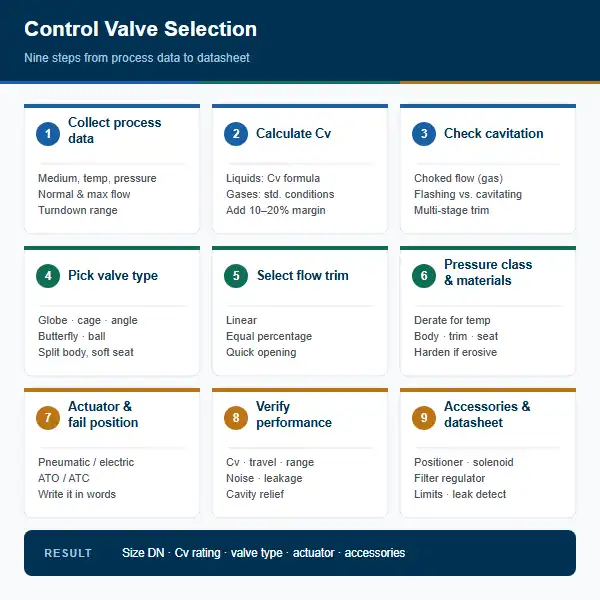
One boundary deserves stating plainly, because causing it costs more than almost anything else on this list. A ball valve isolates; it does not regulate. Held at an intermediate position to control flow, the edge of the ball port acts as a knife on the seat, the relationship between opening and flow is unhelpfully nonlinear, and the damage appears as a valve that no longer shuts off when you next need it to. If you need throttling, specify a control valve for that position.
Two selection axes on this site are worth separating from this one, since they get confused. If the requirement is to service the valve without cutting it out of the line, that is a question about access and belongs to the top entry design, which says nothing about how the ball is supported. If the requirement is to route flow between three ports, that is a multiport switching question and belongs to a three way valve. This page is about load path and torque, which is independent of both.
Key Features
- Bearing-supported ball: line thrust is taken by the trunnion and stem bearings, not pushed into the downstream seat.
- Torque nearly independent of pressure: operating torque tracks size and seat friction rather than the product of pressure and seat area, so the actuator can be sized with confidence.
- Two independent seats: each seat seals its own direction, giving bi-directional shutoff and the ability to verify each seat separately.
- Double block and bleed capability: with the cavity vented, isolation can be proven before the line is opened rather than assumed.
- Defined seat piston effect: single piston effect vents cavity overpressure back to the line; double piston effect seals the cavity as well and then requires its own relief means.
- Full bore or reduced bore: full bore for pigging and unrestricted flow, reduced bore where weight and pressure drop allow it.
- Spring-energized seat rings: the seat maintains contact at low differential pressure, where a pressure-only design would pass.
- Blowout-proof stem: the stem is retained from inside the body, so it cannot be ejected by line pressure with the operator removed.
- Antistatic path: a continuous conductive path between ball, stem and body prevents charge accumulation in dry hydrocarbon service.
- Welded or flanged ends: welded body eliminates the bolted leak path at buried or unmanned sites; flanged body allows removal without cutting.
- Emergency sealant injection option: injection fittings allow temporary sealing of a scored seat without removing the valve from the line.
- Gear or actuated operation: gear operators on hand valves above the size where lever effort becomes unreasonable, with pneumatic, hydraulic or electric actuators for remote operation.
- Low pressure drop when full bore: an open full bore ball valve is essentially a length of pipe, which is why it is the preferred mainline block valve.
- Quarter-turn operation: ninety degrees from open to closed, with visual position indication from the stem or the operator.
- Pipeline duty construction: built for long periods standing open and then one decisive operation under full line pressure.
- Isolation duty only: made to cut the line off or put it into service. Partially open operation erodes the seat at the ball port edge, so throttling belongs to a control valve.
- Wide class coverage: ASME Class 150 through Class 2500, which spans general process lines and high pressure transmission without changing body type.
Typical Applications
- Oil and gas transmission pipelines: mainline block valves where the valve stands open for years and then has to seal once, under full pressure.
- Gathering lines and wellhead manifolds: isolation upstream of processing, where pressure and solids both run high.
- Compressor and pump station isolation: sectionalizing equipment so a single unit can be taken out of service.
- Metering and regulator skids: proving isolation before a meter run or regulator is opened for maintenance.
- Storage terminals and tank farm manifolds: block valves on receipt and dispatch headers, including piggable lines that need full bore.
- City gate and distribution stations: sectional isolation on the inlet side of pressure reducing and metering facilities.
- Process hydrocarbon and chemical headers: any high pressure line where the valve must seal reliably and stay operable.
- Water and steam lines: plant utility and process steam headers where isolation has to hold tight after long periods open.
- Nitric acid, strong oxidizer and urea service: where those duties are handled, with both wetted material and seat selected against concentration and temperature.
- Liquefied gas and town gas: LPG, LNG transfer lines and gas distribution headers requiring tight shutoff and predictable operation.
Specify this valve by fixing size, pressure class, design temperature and the seat arrangement you need, then telling us how the cavity is meant to behave. Size and class set the body, and temperature sets the seat polymer, since the flange rating tells you nothing about whether a PTFE seat survives the duty. Say whether you need double block and bleed verification or true double isolation with both seats holding independently, because that decides the seat piston effect and whether a cavity relief device is required. Give us the line fluid, the pigging requirement and how the valve is operated, and we will confirm body material, trim and actuator sizing against them. One caution on the corrosive duties listed above: nitric acid, strong oxidizers and urea solutions each have their own compatibility rules, and the media list is an application statement rather than a guarantee. Select the wetted materials and the seat polymer against actual concentration, temperature and any upset condition, and tell us those numbers so we can confirm rather than assume.
Technical Specifications
| Valve Type | Trunnion mounted ball valve, quarter turn bi-directional isolation |
|---|---|
| Ball Mounting | Trunnion mounted, with the ball located by a lower trunnion plate and driven by the stem above |
| Bore | Full bore or reduced bore |
| Nominal Size | NPS 2 to NPS 48 (DN 50 to DN 1200) |
| Pressure Class | ASME Class 150 to Class 2500 |
| Design Temperature | PTFE seat up to 120 °C | Nylon seat up to 80 °C | PEEK seat up to 250 °C | PPL seat up to 250 °C |
| Body Material | ASTM A105, ASTM A350 LF2, ASTM A182 F304, ASTM A182 F316, ASTM A694 |
| Body Construction | Split bolted body or fully welded body |
| Ball Material | Carbon steel with electroless nickel plating, ASTM A182 F316, ASTM A182 F51 |
| Stem and Trunnion Material | ASTM A182 F6a, 17-4PH, or ASTM A182 F316 |
| Seat Material | PTFE up to 120 °C, Nylon up to 80 °C, PEEK up to 250 °C, PPL up to 250 °C |
| Seat Type | Spring and pressure energized independent seats | single piston effect or double piston effect |
| Sealing Arrangement | Bi-directional shutoff | double block and bleed with the cavity vented | double isolation and bleed available where specified |
| Cavity Relief | Required where both seats seal against cavity pressure |
| Emergency Sealant Injection | Optional seat and stem injection fittings |
| Stem Design | Blowout-proof stem retained from inside the body |
| Antistatic Design | Conductive path between ball, stem and body |
| End Connection | Flanged to ASME B16.5 for NPS 24 and below, flanged to ASME B16.47 above NPS 24, or butt welding to ASME B16.25 |
| Operation | Manual lever, worm and worm gear operator, pneumatic actuator, electric actuator |
| Media | Oil, natural gas, liquefied gas, coal gas, water, steam, nitric acid, strong oxidizer, urea |
| Design and Manufacture | API 608 and API 6D |
| Seat Leakage | Class VI per ANSI/FCI 70-2, often cited as ANSI B16.104 Class VI, a soft-seated classification judged by bubble count rather than by percentage of rated capacity |
| Face-to-Face | ASME B16.10 and API 6D |
| Pressure Test | API 598 and API 6D, with every valve tested for shell strength and seat tightness before shipment |
| Also Commonly Specified | Fire-tested design API 607 or API 6FA, fugitive emissions ISO 15848-1, sour service NACE MR0175 / ISO 15156. These are purchaser requirements and are offered only where supported by test documentation |
| Industries | Oil and Gas Transmission, Pipelines, Refining and Petrochemical, Gas Storage and Distribution, Terminals, Chemical Processing, Urea and Fertilizer, Power Generation |
Frequently Asked Questions
What is the difference between a trunnion and a floating ball valve?
How the ball is held. In a floating design the ball is free to move and line pressure presses it onto the downstream seat, which is what creates the seal. In a trunnion design the ball is anchored top and bottom, and the thrust goes into the bearings. The consequence is torque: on a floating valve it rises steeply with pressure and size, and on a trunnion valve it is nearly independent of pressure.
When should I move from a floating valve to a trunnion valve?
There is no universal threshold, because it is a manufacturer decision as much as a duty requirement. The usual pattern is that floating valves cover small sizes and moderate pressure, and the trunnion design takes over as size and class increase, particularly in pipeline service. If your actuator sizing is starting to be driven by differential pressure rather than by the valve itself, that is the point to ask.
Does the body cavity need relief?
It depends on the seat arrangement. Seats with single piston effect release unwanted cavity pressure back into the line by themselves. Seats with double piston effect seal against cavity pressure as well, which is what double isolation requires, and then nothing is released automatically. In that case trapped liquid that warms and expands has nowhere to go, so the cavity needs either a relief device or an operating instruction that prevents the situation arising.
Is double block and bleed the same as double isolation and bleed?
No. Double block and bleed means both seats seal and the cavity between them can be vented, so isolation can be verified. Double isolation and bleed adds that the cavity itself is also sealed against pressure, so a single seat failure does not defeat the isolation. Specify which one you need, because a double block and bleed valve is not automatically double isolating.
Does it seal in both directions?
Yes, the two seats act independently, so the valve holds against pressure from either side. This is one of the practical advantages over a floating design, where sealing depends on differential pressure pushing the ball onto a seat.
Can it be used to throttle flow?
No. It is built to cut the line off or to put it into service. Held part open, the edge of the ball port cuts across the seat, and the flow changes almost nothing over much of the travel and then jumps over the rest, so control is poor and the damage shows up as a valve that no longer seals. Use a control valve for that position and leave this one fully open or fully closed.
What about fire-safe and fugitive emissions certificates?
Buyers in hydrocarbon service commonly specify fire testing to API 607 or API 6FA and fugitive emissions testing to ISO 15848-1, and sour service material compliance to NACE MR0175 / ISO 15156. Each of those is backed by a test report, so state them in the enquiry and we will confirm what LAPAR holds documentation for rather than quoting them by default.